AdSense pays publishers 68% of the revenue it recognizes on display ads it serves, and it decides the price of every impression on its own. AdX demand, by contrast, clears through a real-time auction in Google Ad Manager, where multiple buyers compete, first-party data can drive pricing, and the fee structure is visible in reporting. A publisher crossing from one to the other typically does so because volume, geography mix, or inventory complexity has pushed past what AdSense can price efficiently. The upgrade is not automatic, and it is not right for every site, but the signals are identifiable well before revenue stalls.
Two products, one auction, different doors
AdSense and AdX are not competing ad markets in the way publishers sometimes assume. Both ultimately tap Google demand, and both clear through the same underlying auction infrastructure. The difference is the access model, the control the publisher holds, and what sits around the demand.
AdSense is a self-service product with near-zero configuration. You place an ad unit, Google fills it, and you receive a revenue share: 68% for content ads and 51% for search ads. You do not see the buyer, you do not control the floor price per deal, and you cannot layer non-Google demand into the same slot without leaving the product's native flow. Google publishes an official Ad Manager vs. AdSense comparison that frames the split the same way: AdSense for publishers who want simplicity, Ad Manager for publishers who need to manage inventory, direct deals and competing demand in one place.
AdX, formally Google Ad Exchange, is the exchange-side product. Publishers do not get a simple AdX account the way they get an AdSense account. Access comes through Google Ad Manager, either with a full GAM account as a primary partner or through Multiple Customer Management (MCM), where a managing partner operates the GAM infrastructure and shares AdX access with you. Google also publishes a guide on Ad Manager, AdSense, and AdMob explained that maps which product fits which inventory: web, app and video each have a designated entry point, and the Ad Manager route covers all three under one roof.
The practical consequence: AdSense is a doorway into Google demand, while AdX through GAM is a control panel over your entire inventory, including demand that is not Google's.
The capability gap, line by line
The upgrade decision rests on specific capabilities, not on vague notions of "premium". Here is what actually differs.
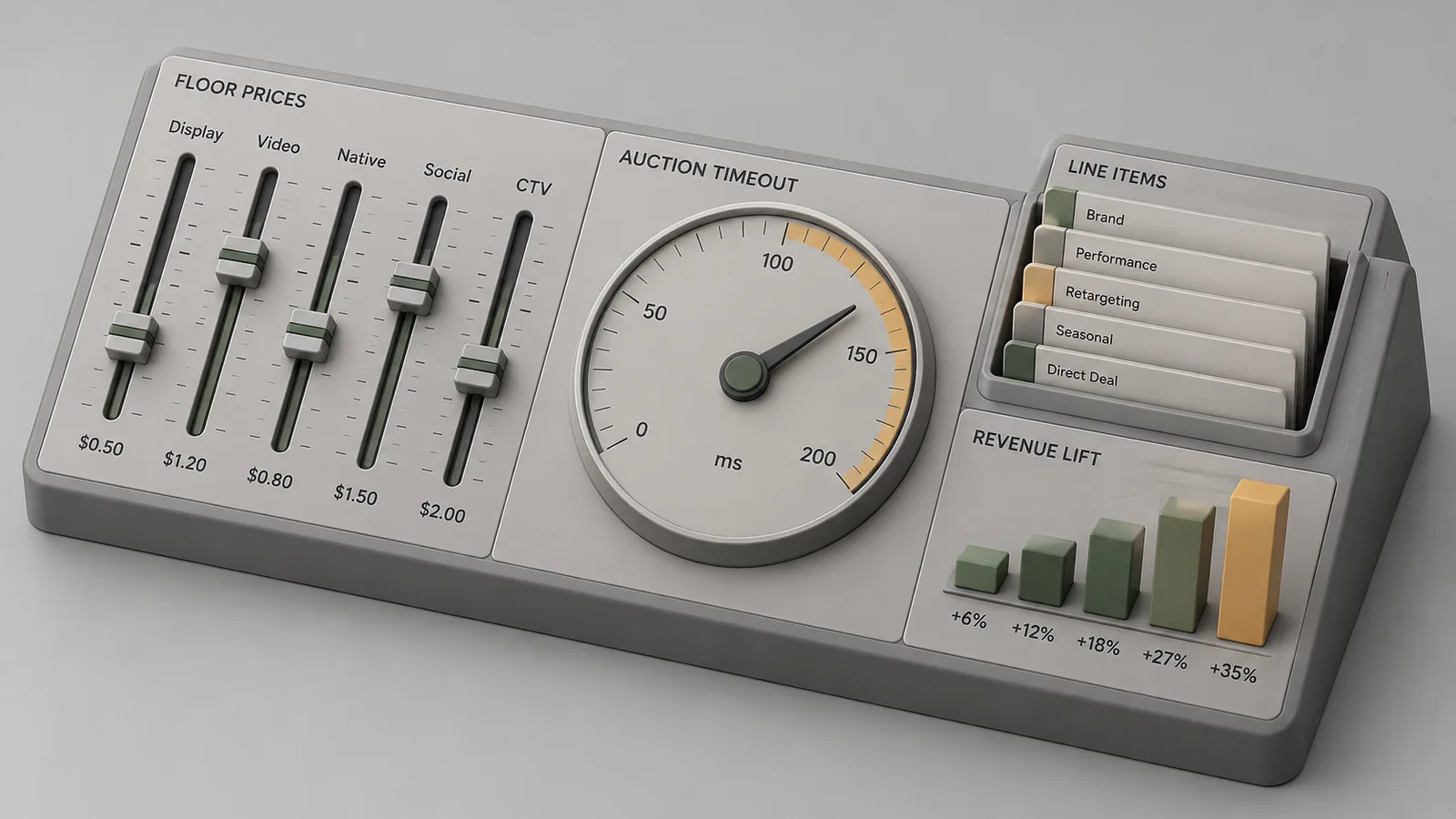
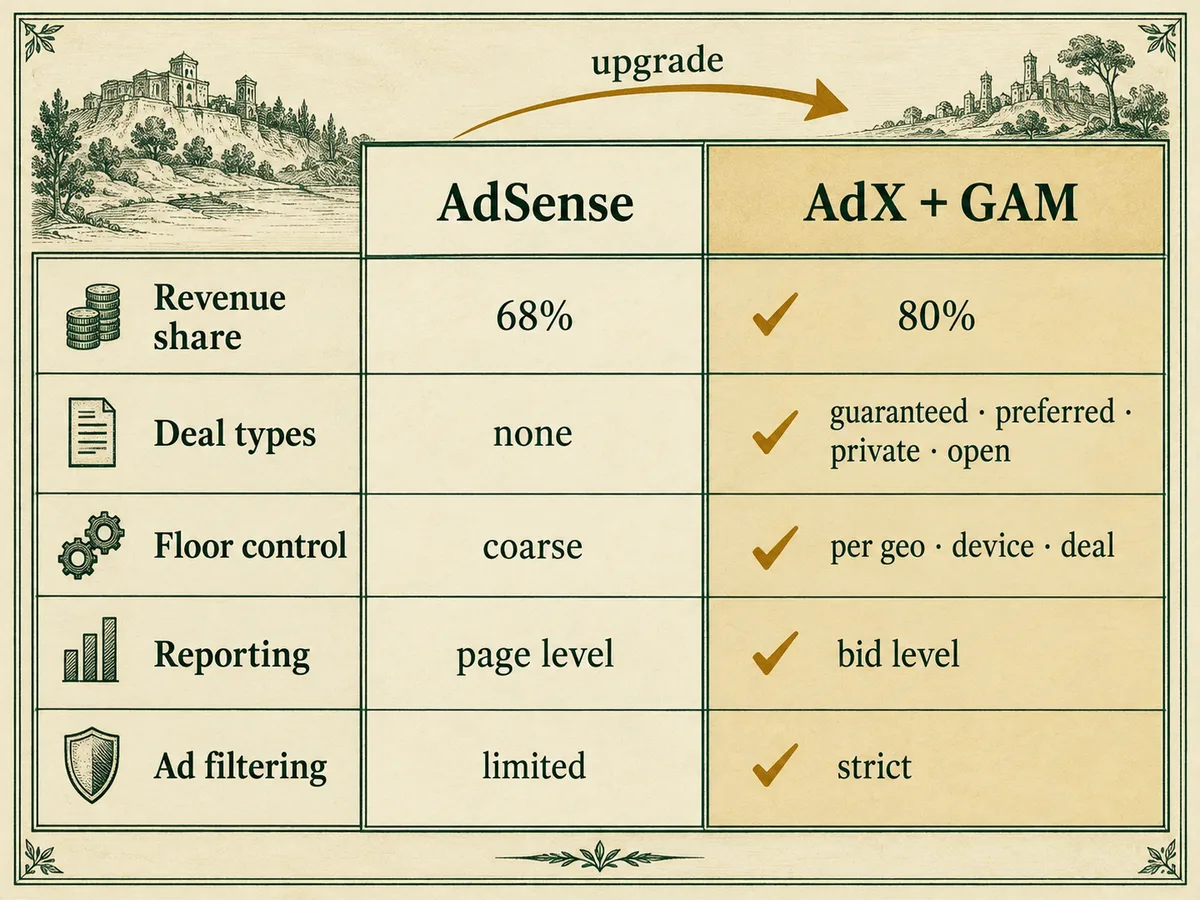
Pricing control. In AdSense you can set floor prices at a coarse level, but the product optimizes toward its own revenue-per-thousand estimate. In GAM you set floor prices per placement, per geo, per device, per buyer, and per deal. You can run a floor price of $1.20 for US desktop video and $0.35 for mobile banner in Southeast Asia simultaneously, and adjust either one based on yesterday's reporting.
Demand competition. AdSense serves Google demand. GAM with AdX serves Google demand plus everything you wire in: Prebid.js header bidding on the page, Prebid Server for server-side demand, direct deals negotiated with brand agencies, and any exchange or DSP that speaks OpenRTB. When a direct deal with a fixed CPM bids against open-market AdX demand, GAM's unified auction picks the winner in one pass rather than letting a waterfall drop impressions sequentially.
Deal types. AdSense offers no direct deal capability. AdX supports programmatic guaranteed, preferred deals, private auctions and open auction. If an agency wants to buy your homepage takeover at a fixed CPM with a frequency cap, that transaction requires GAM.
Reporting. AdSense reports revenue and impressions by page and ad unit. GAM reports by buyer, by deal, by geo, by creative, by bid received (not just bid won), and by line item. Bid-level data is what lets you find the gap between what buyers offered and what floors allowed.
Revenue share mechanics. AdSense's 68% share is fixed and simple. GAM's fees are technically negotiable and, under MCM, the managing partner's share is disclosed to you. The published Google rate for AdX through GAM sits around a 20% cut, materially better than AdSense's 32% for display, though the effective number depends on your setup and your managing partner.
Ad quality and filtering. AdSense gives you limited blocking controls. Through GAM and MCM, a managing partner can apply strict ad quality filtering, brand safety settings and category blocks at the inventory level, before unwanted creatives ever reach your pages.
Signals that AdSense has become the bottleneck
Upgrading too early wastes money on operations you do not need. Upgrading too late costs revenue every day. These are the signals we see most often when a publisher has genuinely outgrown AdSense.
Your impressions pass 1 to 2 million per month. Below roughly a million monthly impressions, the operational overhead of GAM, floor management and header bidding rarely pays for itself. Above two million, the CPM delta between a single-demand setup and a competitive auction typically outweighs the cost of running it. The threshold is a heuristic, not a law: a site with exceptional audience quality can justify the upgrade at 500,000 impressions, and a low-value geo mix may not justify it at five million.
Your effective CPM has plateaued while traffic grows. AdSense revenue scales linearly with impressions until it does not. When your traffic doubles and your RPM stays flat or falls, the likely cause is that AdSense's demand depth in your geos or verticals is saturated. More impressions hit the same buyers with no incremental competition. A competitive auction fixes this structurally by adding bidders rather than adding volume.
Buyers ask for deals you cannot serve. When a media agency emails asking for a direct campaign, a sponsorship, or a guaranteed placement, and your answer is "we only run AdSense", you are leaving the highest-CPM segment of the market unserved. Direct deals routinely clear at CPMs several multiples above open auction for the same placement, because the buyer pays for certainty and exclusivity.
Your audience has data value you cannot activate. If you operate logged-in inventory, a subscription product, or first-party segments that advertisers would pay to target, AdSense gives you no mechanism to price that. GAM lets you build audience segments and expose them to Authorized Buyers and to your direct deal counterparties.
Your traffic is international and unevenly distributed. AdSense prices tier-one geos reasonably well but leaves value on the table in mixed or secondary markets, where a competitive auction with multiple regional exchanges and direct local agency demand changes results. This is one of the clearest cases where the gap is largest.
You can quantify the threshold with arithmetic, not hope. The upgrade pays when the CPM uplift times your volume exceeds the operational cost. If you run 3 million monthly impressions at a $1.10 average CPM, a 25% uplift is worth about $825 per month. Run your own numbers with our CPM calculator against your real volume and a conservative uplift assumption between 15% and 30% for a first migration. That range reflects what competitive demand typically adds for publishers moving from a single source to an auction, and it is the honest basis for a go or no-go decision.
The upgrade route runs through GAM and MCM
You cannot apply to AdX directly in the way you apply to AdSense. The route up has two branches.
Branch one: your own Google Ad Manager account. You apply to GAM, get approved, connect AdX demand, and operate everything yourself. This gives maximum control and maximum responsibility. You manage line items, floor prices, Prebid configuration, ad quality, technical support escalations and payment reconciliation. For publishers with an ad operations team or a dedicated technical resource, this is the full-capability path. Google's MCM program then lets you manage other publishers' inventory if you grow into that role.
Branch two: Multiple Customer Management through a managing partner. Under MCM, a partner like us operates the GAM infrastructure and manages your AdX access. Google introduced MCM to replace the old third-party delegation model, and it comes with structural transparency: the SupplyChain object and sellers.json declare the payment chain, so buyers can verify who gets paid for your inventory. As your managing partner we run GAM, configure Prebid and Prebid Server, set floors per geo and placement, push our direct deals from global and local brand agencies into the auction alongside AdX demand, and apply strict ad quality filtering before creatives reach your users. You keep your content, your placements and your reporting visibility, and we pay you Net 30 on a CPM basis.
The branch choice is an operations decision more than a revenue decision. Both branches reach the same auction. One of them requires you to staff ad operations; the other delegates it.
Header bidding changes the math
The single largest mechanical difference between an AdSense site and an upgraded site is usually not AdX itself. It is header bidding.
On an AdSense page, Google demand arrives without competition. Prebid.js changes that: before the ad server call fires, a header bidding wrapper on the page sends your inventory to multiple demand partners in parallel, collects bids, and passes the top bid into GAM's auction as a line item. Google demand must then beat that bid to win the impression, or a competing exchange serves it. This is the mechanism behind most of the CPM uplift publishers see after upgrading, because it converts a take-it-or-leave-it price into a contest.
Server-side header bidding through Prebid Server extends the same contest to demand partners that cannot or should not run in the browser: additional exchanges, CTV demand, and buyers that would otherwise slow your page down with client-side calls. The trade-off is control over latency and the technical overhead of maintaining server-side connections, which is a core reason publishers route this through a partner rather than in-house.
If you want to see the full stack we run for publishers, including how we combine Prebid, OpenRTB, Google MCM, AdX demand and direct deals so all demand bids highest on your ad spaces, the WireAds SSP page breaks down the architecture. The principle behind it is simple: every impression should reach the maximum number of qualified buyers, and every buyer should have to outbid the others.
What upgrading costs you
The honest version of this article includes the costs, because they are real and they filter out publishers who should stay on AdSense.
Operational overhead. GAM is a professional ad server. Floor management, deal setup, creative QA, disapproved-ad handling and reporting analysis take hours per week. Under MCM with a managing partner, we absorb most of this, but you still review reporting and make inventory decisions.
Technical work. Prebid.js integration, ad unit restructuring, lazy loading configuration and consent management (TCF strings, Global Privacy Control signals) require developer time up front. Budget days, not hours, for the initial integration, then occasional maintenance.
Payment terms. AdSense pays on the 21st of the following month. MCM partners set their own terms; we pay Net 30, which is comparable in practice, but you should check terms with any partner you evaluate.
A learning curve on floors. Set floors too high and fill collapses; too low and you underprice. The first six weeks after migration involve calibration, and CPMs during that window are not representative of steady state.
A staged migration path
We recommend migrating in stages rather than switching everything at once, and this is how we run it with publishers who come to our publisher monetization services team.
Stage one: audit. We review current AdSense performance by geo, placement and device, and model the uplift scenario against your volume using conservative assumptions.
Stage two: parallel test. We implement GAM and Prebid on a section of the site or a share of impressions, running AdX and header bidding demand against your AdSense baseline. Two to four weeks of parallel data tells you the real delta for your inventory, not an industry average.
Stage three: full cutover and calibration. Once the test confirms the uplift, we migrate all inventory, tune floors per geo and placement, layer in direct deals where your vertical supports them, and move you to steady-state reporting. From that point the work shifts from migration to optimization: quarterly floor reviews, new demand partners added as they clear quality checks, and deal opportunities surfaced from our agency relationships.
AdSense remains the right product for publishers under the volume threshold, without direct deal demand, or without the appetite for ad operations. For everyone else, the capability gap is not marginal. It shows up as CPMs that a single demand source cannot reach, as direct buyers you cannot serve, and as first-party data you cannot price. The signals appear well before the revenue curve flattens, and the publishers who act on them early capture the compounding difference every month thereafter.