
A bid request sent without a stable user identifier typically prices 30 to 60 percent lower than the same request carrying a recognized ID, because demand partners bid conservatively when they cannot match the impression to a known profile. That gap is the central problem header bidding now faces. Third-party cookies still function in some browsers, but their coverage shrinks every quarter as blocking defaults spread, as mobile app traffic grows, and as privacy regulation forces consent restrictions on top of technical ones. Prebid, the open-source header bidding framework that powers a large share of publisher auctions, is not going away. It is changing what it carries: less borrowed identity, more publisher-owned signals, and richer contextual and supply metadata that lets buyers price inventory without a cookie.
This article covers where header bidding goes as identifiers thin out, which replacement mechanisms actually work in production today, and what a publisher should do in the next two quarters to protect revenue. We also explain, briefly and honestly, how we at WireAds model cookieless demand in our own SSP so that publishers understand where our estimates come from.
What third-party cookie loss actually changes in a bid request
Header bidding works by letting multiple demand partners bid on the same impression before the primary ad server runs its own auction. For years, the bid request carried a third-party cookie ID that each exchange could match against its own user graph. That ID did three jobs: frequency capping, audience targeting, and fraud filtering. When the ID disappears, all three jobs need new inputs, and each one degrades differently.
Frequency capping degrades first and hardest. Without a durable ID, a single user can see the same creative six times in an hour, which drives down effective CPMs even when nominal win rates hold. Buyers respond by bidding lower to compensate for uncontrolled frequency, or by shifting budget to inventory where they can still cap. Audience targeting degrades more gradually. Buyers replace user-level segments with contextual segments, first-party data deals, and publisher-declared audience packages, all of which price lower per impression but scale better across consented and unconsented traffic.
Fraud filtering is the quiet third effect. Many exchanges use cookie presence as one trust signal among several. When the cookie vanishes for everyone, that signal stops discriminating between good and bad traffic, and buyers lean harder on supply chain verification: sellers.json, the SupplyChain object, ads.txt, and app-ads.txt. This is why clean supply metadata now functions as a revenue mechanism, not a compliance chore. A publisher with a complete, correct SupplyChain object and verified sellers.json entry gets bid consideration that a murky supply path does not, and the difference shows up in average CPM.
The OpenRTB protocol itself carries all of these signals natively. The user object holds first-party IDs and consent strings, the site and app objects hold contextual metadata, and the source object carries the SupplyChain. Publishers who keep their OpenRTB readiness at a high standard lose far less from cookie loss than publishers who send sparse, malformed bid requests, because every remaining signal has to work harder.
The identifier stack that replaces the cookie
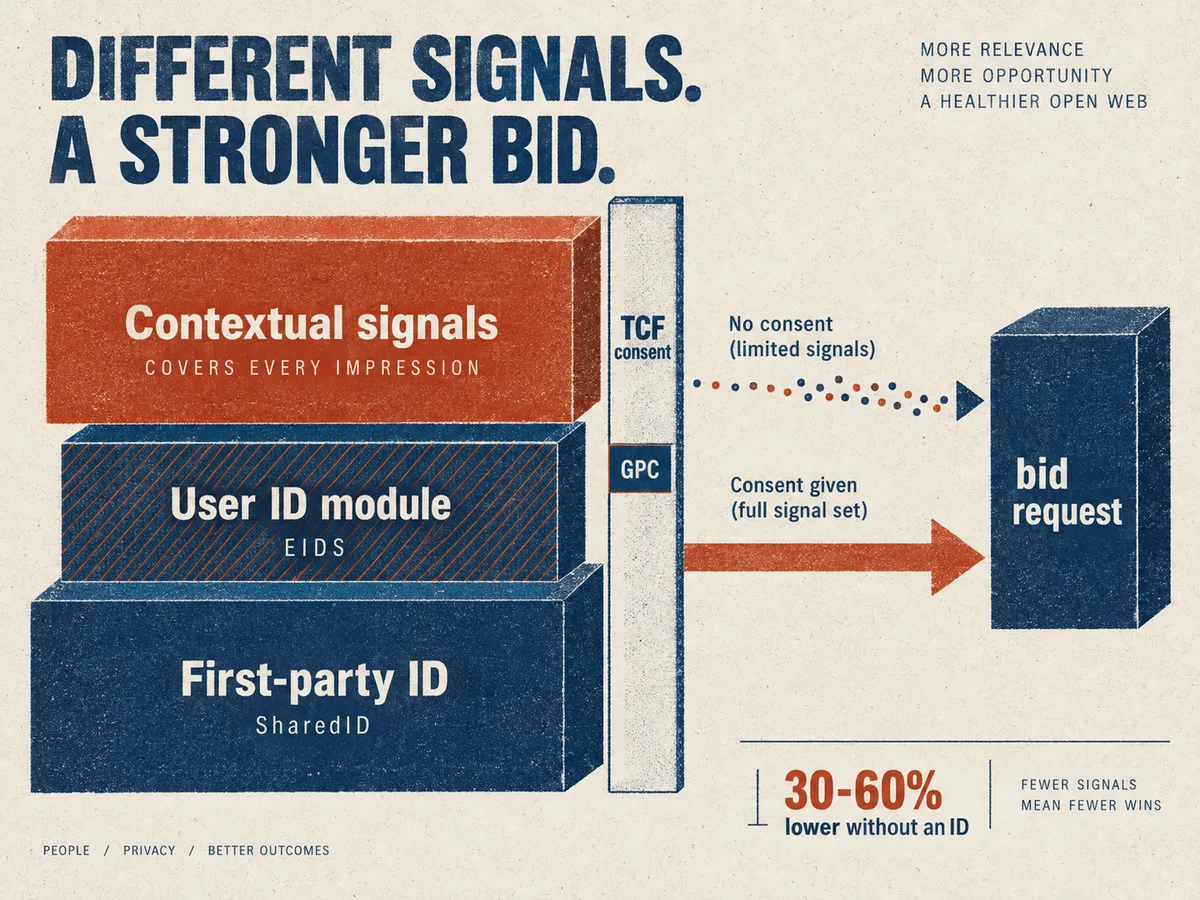
No single replacement for the third-party cookie exists. What exists is a stack of partial identifiers, each covering a slice of traffic, and the publisher's job is to layer them so that the maximum share of impressions carries at least one addressable ID.
First-party IDs sit at the base of the stack. A first-party ID is a random value set in a cookie or app storage on the publisher's own domain, readable only by the publisher and by partners the publisher explicitly passes it to. Because it lives on your domain, it survives third-party cookie blocking, subject only to consent. Prebid provides a reference implementation, and the Prebid SharedID first-party ID sets a first-party random ID cookie on the publisher domain, which downstream modules and partners can consume when consent allows. First-party IDs solve frequency capping and logged-in recognition within your own audience, but they do not by themselves connect you to buyer-side user graphs.
On top of that sit alternative IDs and ID graphs: hashed email-based IDs, privacy-passing identifiers, and vendor-maintained graphs that match first-party IDs to broader segments. In Prebid, the standard plumbing for all of these is the Prebid User ID module, where resolved identifiers ride into bid requests via the userId structure and the EIDS format that OpenRTB buyers read. A publisher configures the module with consent gating, the module resolves whichever ID partners it supports, and each bid request leaves the page carrying the IDs that particular consent state permits.
Contextual signals form the third layer, and they matter more with every quarter. Category-level page context, page-level key-values, declared audience packages, and content metadata let buyers target without any ID at all. Contextual CPMs typically run below user-targeted CPMs, but they scale across 100 percent of traffic, including the consented-out share that no ID can reach.
Consent strings are the connective tissue across the stack. A valid TCF consent string determines whether IDs transmit at all in Europe and other regulated regions, and Global Privacy Control signals can suppress them further. Publishers who treat consent management as an afterthought lose the entire identifier stack on a large share of impressions, which converts a technical problem into a revenue problem. The IAB Europe post-cookie guides in the IAB Europe knowledge hub cover the current recommended patterns for identity and consent handling, and we recommend publishers and ad ops teams read them directly rather than rely on vendor summaries.
Prebid's role shifts from wrapper to identity router
Prebid started as a client-side auction wrapper: a JavaScript library that collected bids from exchanges in parallel before the ad server auction. That description is now incomplete. In a cookieless environment, Prebid's value comes as much from what it attaches to the bid request as from the auction timing itself.
Three functions now dominate. First, identity orchestration: the User ID module, first-party ID generation, consent gating, and passing EIDS into outbound requests. Second, signal enrichment: Prebid config can attach first-party data, contextual key-values, and floor prices per slot, which lets buyers price impressions without user-level matching. Third, supply chain integrity: Prebid Server and client-side adapters forward the SupplyChain object and seller identity so downstream buyers can verify the path.
Server-side header bidding, running through Prebid Server, adds two cookieless advantages. It reduces page latency by moving the auction off the browser, and it lets the server-side layer maintain IDs and relationships that browser restrictions complicate. Most sophisticated publishers now run a hybrid: client-side Prebid for a core set of bidders with direct cookie access where available, and Prebid Server for the long tail of demand partners. The hybrid pattern also simplifies adapter maintenance, since server-side integrations update centrally instead of requiring a new JavaScript release on every publisher page.
The auction logic itself barely changes. Header bidding was always a price competition, and price competition works fine without cookies. What changes is the information set each bidder holds when it prices. Publishers who feed the auction better information, through IDs, context, and verified supply paths, capture the demand that competitors with sparse requests forfeit.
What publishers should do now
The practical playbook is short and unglamorous. We recommend publishers execute these steps over the next one to two quarters.
Audit your current identifier coverage. Pull a sample of bid requests and measure what share carries any ID, a consent string, and a complete supply chain object. Most publishers we onboard are surprised by the gaps: missing app-ads.txt entries, incomplete sellers.json, and User ID modules that never got consent-gated correctly.
Deploy a first-party ID with consent gating. Implement SharedID or an equivalent first-party identifier on your domain, wire it into the User ID module, and confirm it only transmits when consent permits. This single step restores frequency capping and gives your demand partners a stable matching key for your audience.
Enrich context at the page level. Pass content category, article metadata, and audience key-values into Prebid config. Contextual signals monetize the traffic that no ID can reach, and they directly support the brand-safety checks buyers run.
Verify your supply chain end to end. Confirm ads.txt and app-ads.txt list every reseller, that your sellers.json is current, and that the SupplyChain object propagates through every hop including your SSP. Buyers increasingly discount or skip opaque paths, and you pay for that discount.
Consolidate demand through a managed layer. Running 15 client-side adapters yourself means maintaining 15 integration surfaces as identity formats evolve. A managed Prebid management setup, or an SSP that aggregates demand into one server-side endpoint, lets you adopt new ID formats and consent rules once instead of fifteen times.
Test and measure by segment. Split reporting into consented ID traffic, consented no-ID traffic, and unconsented traffic. Cookieless degradation is not uniform, and you cannot fix what you cannot see. Publishers who segment this way find that fixing one segment, usually the consent gap, recovers measurable revenue within weeks.
On the demand side, quality matters more as targeting thins. When buyers lose user-level precision, they compensate by concentrating spend on inventory they trust, which means verified supply paths and filtered ad sources. We aggregate premium demand, including Google AdX through Google MCM, direct deals from brand agencies, and vetted exchanges, and we filter aggressively before that demand ever reaches your placements. Publishers can read about our approach to brand-safe demand to understand why filtering raises, not lowers, effective CPMs in a cookieless market.
How WireAds models cookieless demand and pricing
Because we operate both an SSP and an ad network, we run our own modeling on how identity loss affects bids, and we think publishers deserve transparency about where our numbers come from.
Our approach has three parts. First, we segment inventory by identifier state: first-party ID present, alternative ID present, contextual only, and no signals beyond supply metadata. Second, we track bid density, meaning the number of distinct bidders responding per impression and the spread of their bids, across those segments. Third, we normalize for placement, geography, and viewability so that identity effects do not absorb unrelated variables.
The pattern our data shows is consistent with what the broader market reports. Inventory carrying a consented first-party ID typically clears meaningfully higher than contextual-only inventory, with the gap widest in verticals where audience precision carries the most buyer value: finance, automotive, and travel. Contextual-only inventory does not collapse, it reprices, and its floor holds up best where content metadata is rich and the supply path is fully verified. We use these segment-level curves to set floor prices dynamically, to route impressions toward the demand sources that value each signal mix most, and to decide which direct deals to prioritize for which inventory segments.
One estimation note deserves honesty. Nobody can predict cookieless CPMs precisely, because the outcome depends on variables outside any single publisher's control: how quickly browsers restrict further, how buyers rebalance budgets between user-targeted and contextual campaigns, and how widely alternative ID adoption spreads. We publish ranges and mechanisms, not point forecasts, and we flag every estimate as typical rather than guaranteed. Publishers should treat any vendor promising exact cookieless revenue figures with skepticism.
What we can state from direct observation: publishers who combine first-party IDs, enriched context, verified supply chains, and consolidated demand consistently outperform, on identical content, publishers who rely on third-party cookies that no longer arrive. That gap is the controllable part of the cookieless transition, and it is work you can start this quarter.
Header bidding survives the cookie because its core mechanism, parallel price competition, never depended on the cookie in the first place. The identifiers did. Publishers who own their identifiers, their consent flows, and their supply chain metadata will keep the auction full of informed bidders, and that is what determines CPMs in every future browsers ship.