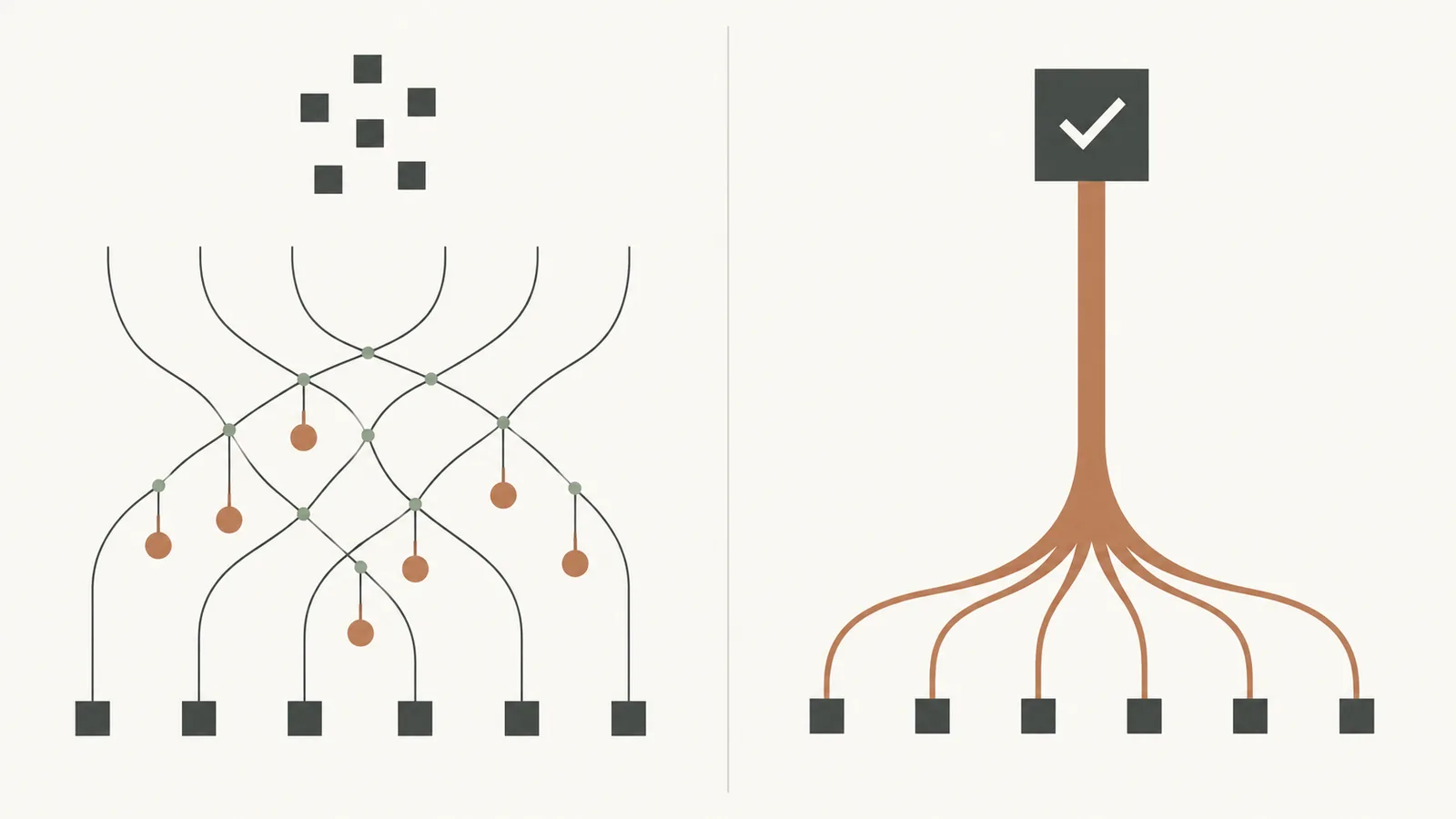
A publisher that switches SSPs usually needs two full monthly reporting cycles before the numbers settle, because bid density, fill rate and CPM all move for weeks after a new demand stack starts bidding on the inventory. Any evaluation shorter than that measures noise. The same logic cuts both ways: a wrong SSP choice can quietly cost a mid-size site a meaningful share of annual revenue, and no single line item in the reports will show why.
An SSP sits between your ad server and the demand side. It receives your impressions as OpenRTB bid requests, runs an auction across its demand sources, returns the winning bid to your ad server, and bills the buyer so you collect one payment instead of hundreds. That position gives the SSP three levers over your revenue: which buyers see your inventory, what those buyers learn about it, and how much of the buyer's money reaches you after the path takes its cut. Every dimension in this guide examines one of those levers.
Most SSP sales decks look alike. They promise premium demand, high fill and fast payments, and they quote the same category benchmarks. The differences that decide your revenue sit in places sales teams rarely detail: who actually bids on your impressions, how many distinct bids each auction attracts, what the SSP filters before a creative reaches your users, and when the money clears.
This guide works through eight evaluation dimensions, in the order we would apply them to our own shortlist. We use WireAds as the running example because we can state our own setup precisely: we run an SSP and an ad network, we price CPM-based, we pay Net 30, and we combine Prebid, OpenRTB, Google MCM, Google AdX demand and direct agency deals into a single auction.
Demand composition decides what your inventory is worth
An SSP's value comes from the composition of its demand, not from the number of logos on a partner slide. Two SSPs can both claim hundreds of buyers while one mostly resells open exchange impressions that the other already bids on. When the same impression travels through three intermediaries before a DSP sees it, every hop takes margin and none of them adds bids.
We structure demand in four layers. Open market demand from exchanges, DSPs and other supply-side platforms provides breadth across geos and verticals. Google AdX demand, via Google MCM and the Authorized Buyers channel, provides depth on premium display and video. Direct deals from global and local brand agencies provide firm floors on specific formats, seasons and countries. Prebid and OpenRTB demand ties the layers together so every source bids on the same impression in the same auction.
Direct deals deserve a specific question, because they move CPMs more than any other layer. A brand agency deal that guarantees a floor on 300x600 units in Germany does more for a German publisher than twenty exchange adapters. Ask what share of the SSP's revenue comes from direct and PMP deals, and ask for the agency verticals it covers in your top geos. We hold direct deals from both global holding-agency groups and local shops, and we push all of them into the same auction as open demand so the highest bid wins regardless of source.
Reselling shows up in the numbers if you look. Ask for the buyer list per impression rather than per account, and count how many distinct DSPs actually bid. An SSP that reports fifty partners and three active bidders on your inventory has a partner slide, not a demand stack.
You can see how we lay out these layers on the WireAds SSP platform page. Use it as a template: demand classes, format coverage, and which sources bid where. Then ask every other candidate for the same breakdown in writing.
Bid density drives revenue more than headline CPM
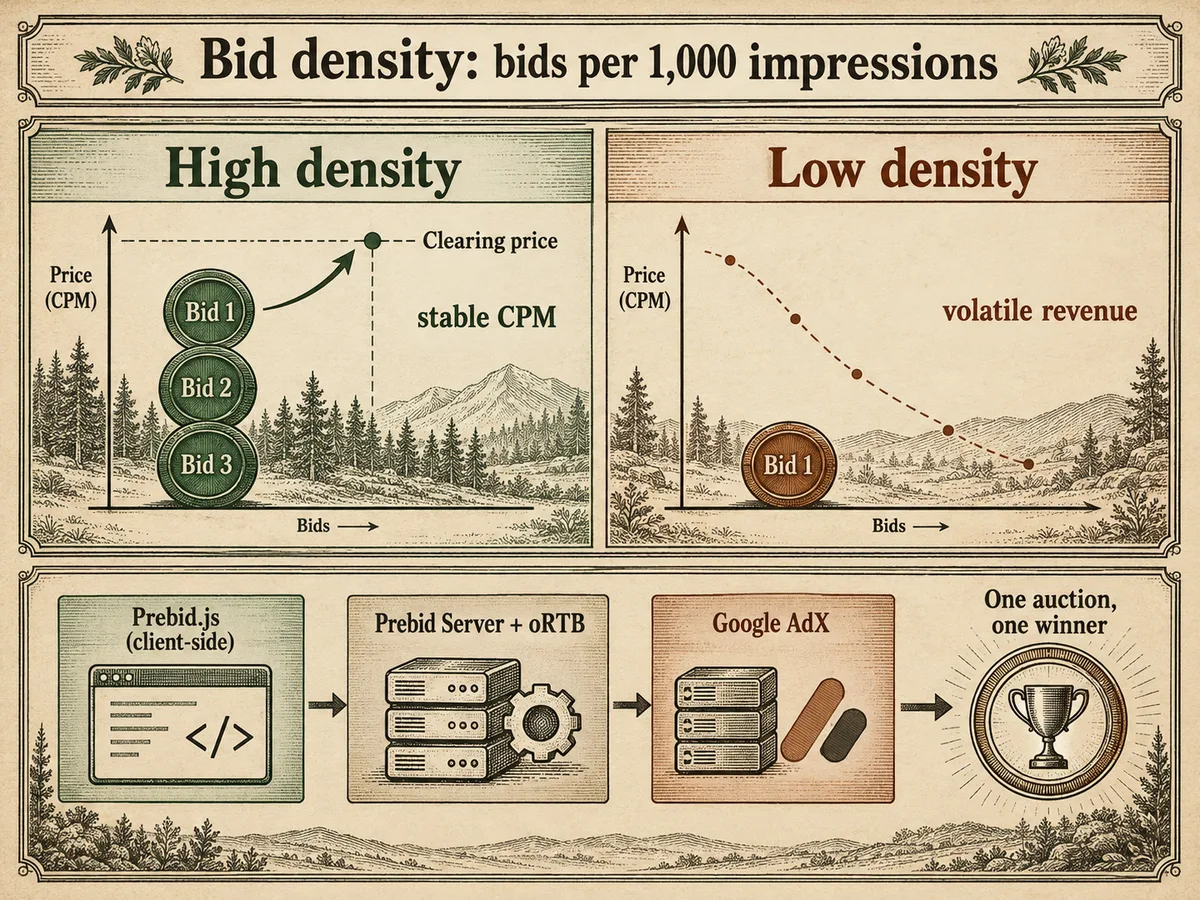
Bid density means the number of distinct, valid bids an auction attracts per thousand impressions. High density produces stable CPMs, because the second and third bids push the clearing price toward the top bid. Low density produces volatile revenue, because one buyer's quarterly budget cycle then decides your quarterly income.
Architecture determines density. Client-side Prebid.js reaches demand that needs browser context, such as user-level signals and viewability measurement, but it costs page load time and starts hurting returns around a dozen adapters. Server-side Prebid Server and OpenRTB connections reach far more demand with zero page cost, but each server-side hop can obscure the buyer and add take rates along the path.
We run both layers together. Prebid.js in the browser captures demand that requires client context, Prebid Server and oRTB connections add server-side scale, and Google AdX competes in the same unified auction instead of sitting in a separate waterfall. One auction, one winner: the highest bid takes the impression no matter which layer produced it.
First-party data changes the math again. If you hold logged-in audience segments, ask how the SSP passes key-value signals into the bid request and which demand partners can read them. Server-side connections can carry data segments through oRTB, but only if the SSP builds the pass-through. Publishers with strong audience data should treat this as a CPM multiplier, and publishers without it should ask what contextual signals the SSP enriches on its own.
Ask candidates three architecture questions. How many demand adapters run client side versus server side? What auction timeout do they recommend, and what share of bids arrives after it? Do they run a unified auction or a sequential waterfall? The third answer alone tells you whether the SSP sells modern header bidding or a dressed-up daisy chain.
Ad quality filtering protects revenue and retention
Bad creatives cost more than they earn. Auto-redirect ads drive users off the page, heavy creatives slow load and crush viewability, and malware or misleading buttons trigger browser warnings that suppress traffic for weeks. Each of those outcomes lowers the CPMs your clean impressions can command, because buyers price inventory on its history.
Filtering should work in layers. Creative scanning catches heavy payloads and suspicious redirects before serving. Category and domain blocklists remove low-quality advertisers and entire verticals on request. Buyer verification through ads.txt and Authorized Buyers settings blocks unauthorized resellers. Inventory access rules under Google MCM decide which Google demand can see your impressions at all.
We hold our ad sources to premium brand standards and we filter unwanted ads strictly, because one bad creative on a premium property damages trust with both the publisher and the buyer. Ask every SSP for its written filtering policy, its creative review process, and its escalation path when a bad ad slips through. The last item matters most, because bad ads slip through every filter eventually.
Two measurement points belong in the same conversation. Viewability measurement determines which demand can bid at all, since many programmatic buyers bid only above a 50 percent viewability threshold. Ask how the SSP measures viewability, what it does with invalid traffic flags from external scanners, and how quickly it removes flagged buyers.
Test the claims rather than trusting them. Send a small traffic slice through the candidate, browse it yourself on mobile and desktop, and track user complaints and bounce deltas for two weeks. Filtering quality shows up in the second week, after the SSP's sales-side attention moves elsewhere.
Transparency signals you can verify before signing
You can audit an SSP's honesty before you sign anything, using three public standards and one Google mechanism.
- The IAB ads.txt authorized sellers standard lets you publicly declare every seller authorized to trade your inventory. Check each candidate's own ads.txt file for its publisher relationships, and confirm the SSP will appear in yours with the correct account ID and relationship type. This file is the baseline trust check for any shortlist.
- sellers.json seller transparency discloses whether an SSP declares itself a direct seller or an intermediary for a given publisher. If a candidate shows up as an intermediary on inventory it claims to sell directly, ask why before you sign.
- The IAB SupplyChain object (schain) lets buyers see every payment-taking party in the bid request path. Ask whether your SSP passes schain on your impressions, request a sample bid request, and read the object yourself.
Google MCM adds a fourth check. Because MCM inventory moves through Google Ad Manager, the managing partner relationship appears in your own GAM account, and you can confirm which partner controls which inventory. We operate under MCM, so this audit trail exists for every publisher that works with us.
These signals matter to revenue, not just to your compliance calendar. Buyers pay more for paths they can verify, and DSPs increasingly block bid requests with missing or inconsistent supply chain data. An SSP that passes clean ads.txt, sellers.json and schain signals earns higher bids for the same impression than one that does not.
Privacy and consent infrastructure sets your ceiling
Consent infrastructure decides how much of your audience buyers can actually bid on. In the EU, the IAB Europe TCF framework carries consent signals through the bid request, and a missing or malformed consent string suppresses demand on those impressions. In California, the Global Privacy Control header gives users a browser-level opt-out that your stack must respect. An SSP that drops these signals costs you revenue twice: once on the suppressed impressions and once on the compliance risk.
Ask three questions. How does the SSP pass TCF consent strings and Global Privacy Control signals into bid requests? What happens to impressions without consent, do they route to contextual-only demand or die? Which geos does the SSP support with localized consent handling? The answers separate an SSP with real privacy engineering from one that treats consent as a checkbox.
Contextual-only demand still pays. Impressions without consent sell to buyers who bid on page context rather than user data, and a good SSP maintains those paths instead of discarding the traffic. Ask what share of your geo mix typically clears without personalized bids, because that number sets your floor in privacy-heavy markets.
CPM mechanics, floors and format coverage
The pricing model matters more than its label. CPM-based pricing makes revenue predictable and comparisons clean, because you measure what buyers pay per thousand impressions rather than a blend of CPC and CPA outcomes converted after the fact. Ask each SSP how it prices, how it reports, and whether the reported CPM is gross or net of its fees.
Coverage decides whether the SSP can monetize your whole audience. We work globally, in every country that has Google monetization, across web, app and CTV/OTT. CTV needs VAST tag support and server-side connections, apps need SDK or webview integration, and long-tail geos need local agency demand rather than remnant passes. An SSP with strong US display demand and weak LATAM app demand strands a third of a global publisher's impressions.
Video and CTV deserve their own numbers. Video CPMs typically run several times display CPMs in the same geo, and CTV runs higher still, but fill behaves differently: CTV demand concentrates in fewer, larger deals, so one lost agency relationship can halve a CTV fill rate. Ask each SSP for its VAST support, its server-side CTV connections, and the share of its CTV demand that comes from direct deals rather than open market.
Floors need strategy, not defaults. A single floor across a site wastes money on high-value units and chokes fill on low-value ones. Ask how the SSP handles price floors per format, geo and device, and how often it revisits them. Seasonality belongs in the same conversation: Q4 CPMs typically run well above Q1 in most verticals, and a floor set in December will underprice February inventory.
Model the tradeoffs before you negotiate. Our CPM calculator lets you compare scenarios: fill gains against CPM losses, floor increases against fill drops, and net revenue after payment terms. Run each candidate's quoted numbers through it, because a quoted CPM without a fill assumption means nothing.
Payment terms and revenue share disclosure
Payment terms decide cash flow, and cash flow decides whether the relationship survives its first quarter. Net 30 means January's impressions pay out by the end of February. Net 60 and Net 90 terms quietly cost two to three months of working capital per year, and some networks hold a reserve against clawbacks without stating it in the pitch.
We pay Net 30 and we state our revenue share openly instead of burying it in a blended net CPM. Ask every candidate for four specifics: payment terms, revenue share or fee structure, reserve and holdback policy, and minimum payout threshold. Then ask for a sample payment statement, because the statement shows deductions that the deck omits.
Discrepancy reporting belongs in the same conversation. Compare the SSP's impression counts against your Google Ad Manager counts every month. A gap above five percent signals counting differences or undisclosed reselling. A gap that grows month over month means the path changed, and you deserve a specific answer about what changed.
Currency and payment rails close the evaluation. Ask which currencies the SSP pays in, which payment methods it supports, and what happens with bank fees on cross-border transfers. For publishers operating in multiple countries, these details decide whether a good gross CPM survives the transfer.
Integration effort and operational support
Integration effort predicts ongoing friction. A modern SSP should slot into your existing stack: Google Ad Manager for ad serving, Prebid.js for header bidding, an SDK for apps, and VAST endpoints for CTV. If integration requires ripping out your ad server or rebuilding your wrapper, migration cost will eat the first quarter of any CPM gains.
Support quality shows up in month two, after the sales engineer stops replying. Ask for a named operations contact, a response commitment for revenue-impacting issues, and access to a reporting API so your team can pull bid-level data without filing tickets. We assign publishers a direct ops contact because monetization problems lose money by the hour.
Reporting deserves its own checklist. At minimum you need daily revenue by ad unit, geo and device, plus bid-level data through an API for your analysts. Ask for a sample report before you sign, check whether it breaks out demand source, and confirm the numbers reconcile with your Google Ad Manager counts within a stated tolerance.
The integration path for publisher monetization at WireAds follows this pattern: MCM access for Google demand, a Prebid.js configuration for header demand, and oRTB endpoints for app and CTV inventory. One stack, one reporting surface, one payment. Ask each candidate to draw the same picture for their setup on a single page, and treat anyone who needs ten pages with suspicion.
Migration timing deserves a line of its own. Run the new SSP in parallel on a traffic slice before you cut over fully, keep the incumbent live until the trial numbers stabilize, and schedule the full switch for a low-traffic week rather than the start of a quarter. Publishers that skip the parallel run inherit two stacks' problems at once.
The scorecard and the 90-day trial
Turn the eight dimensions above into a weighted scorecard before you talk to anyone, so a good demo cannot move the weights.
- Demand composition, 15 points: revenue share from direct, PMP, Google and open demand, in your geos.
- Bid density, 15 points: valid bids per thousand impressions, measured on your traffic, not quoted.
- Ad quality, 10 points: filtering layers, written policy, escalation path, and your own test traffic.
- Transparency, 15 points: ads.txt, sellers.json and schain all verifiable before signature.
- Privacy and consent, 10 points: TCF and Global Privacy Control handling, with clear routes for non-consented impressions.
- Coverage and pricing, 10 points: geos, formats, CPM model, floor strategy.
- Payment terms, 15 points: Net 30 or longer, share disclosed, reserve policy.
- Support, 10 points: named contact, reporting API, response commitments.
Then run a trial, not a demo. Allocate one traffic slice, hold floors constant, and run the candidate against your incumbent for 60 to 90 days on identical inventory. Measure bid density, fill rate, net eCPM, discrepancy against GAM, and whether the first two payments arrive on the terms the contract states.
Watch for specific red flags during the trial. CPMs that spike in week one and decay by week four usually mean the SSP front-loaded budget to win the account. Fill that improves only after you complain means someone tuned floors manually. A payment that arrives late once with a vague excuse predicts the second late payment.
Contract terms belong in the scorecard too. Look for a term you can exit after the trial period, a clause that lets you audit demand paths, and payment terms stated in days rather than "upon receipt". Auto-renewal clauses with 90-day notice windows have trapped more publishers than any CPM shortfall.
The trial answers the question sales decks cannot: what does this SSP do to revenue on your inventory, with your users, in your geos. A candidate that wins on the scorecard and the trial earns the relationship. One that wins only on the pitch does not, and the numbers you gathered during the trial give you the evidence to say so.