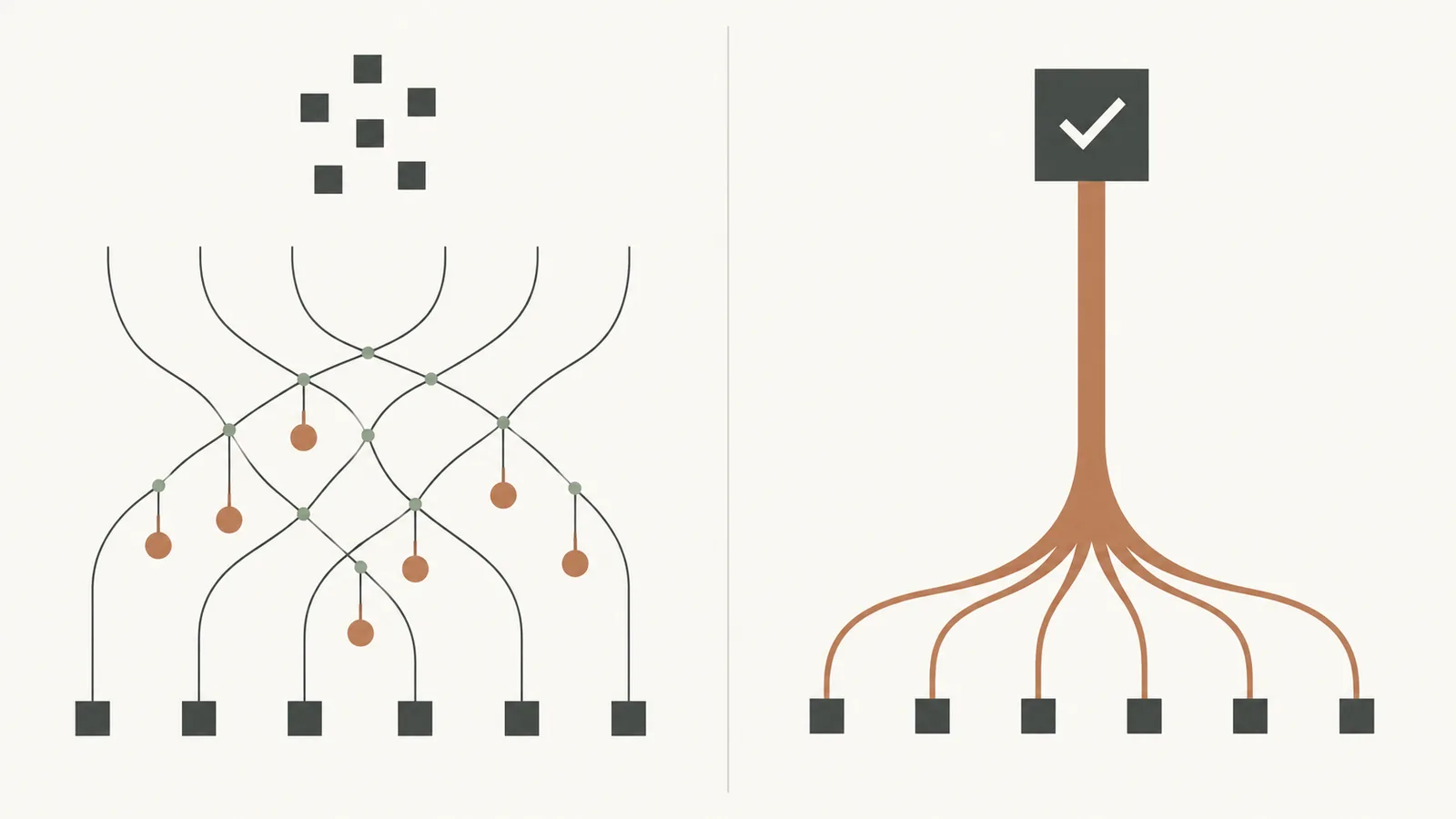
Two supply-side platforms can quote the same gross CPM on the same placement and still pay net figures that differ by 20 percent or more. The gap hides in three places: the demand stack behind the quote, the fee chain disclosed in sellers.json, and the creative filtering that decides which ads actually serve. Most articles that promise a top ten list rank company names, but names age badly and often reflect referral commissions rather than performance in your geo and format mix. We take a different approach here. Each of the ten items below is a test, a question with a verifiable answer, that you can run against any SSP or ad network before you commit meaningful inventory. We use our own operation as the worked example throughout, so you can see what a complete answer looks like, and so you can recognize where an incomplete answer should worry you.
Why capability tests beat vendor rankings
A ranked vendor list would go stale within a year and would say nothing about fit. A premium publisher with five million monthly sessions in DACH faces different constraints than a US entertainment site with heavy video inventory, and both differ from a mobile app monetizing through app-ads.txt. The durable questions concern mechanics: how demand reaches the auction, how the supply chain discloses itself to buyers, how the partner treats payment, and who answers the phone when a creative malfunctions. Mechanics transfer across vendors, so test them instead of collecting names.
As a reference point, we run both an SSP and an ad network. We combine Prebid, OpenRTB (oRTB), Google MCM, Google AdX demand and direct deals from brand agencies into a single auction, so all demand competes on the same ad spaces and the highest bid wins. We work CPM-based, pay Net 30, and operate globally across web, app and CTV/OTT in every country that supports Google monetization. The ten tests below ask any candidate partner, including us, to prove the same fundamentals.
Test one: header bidding architecture and Prebid hygiene
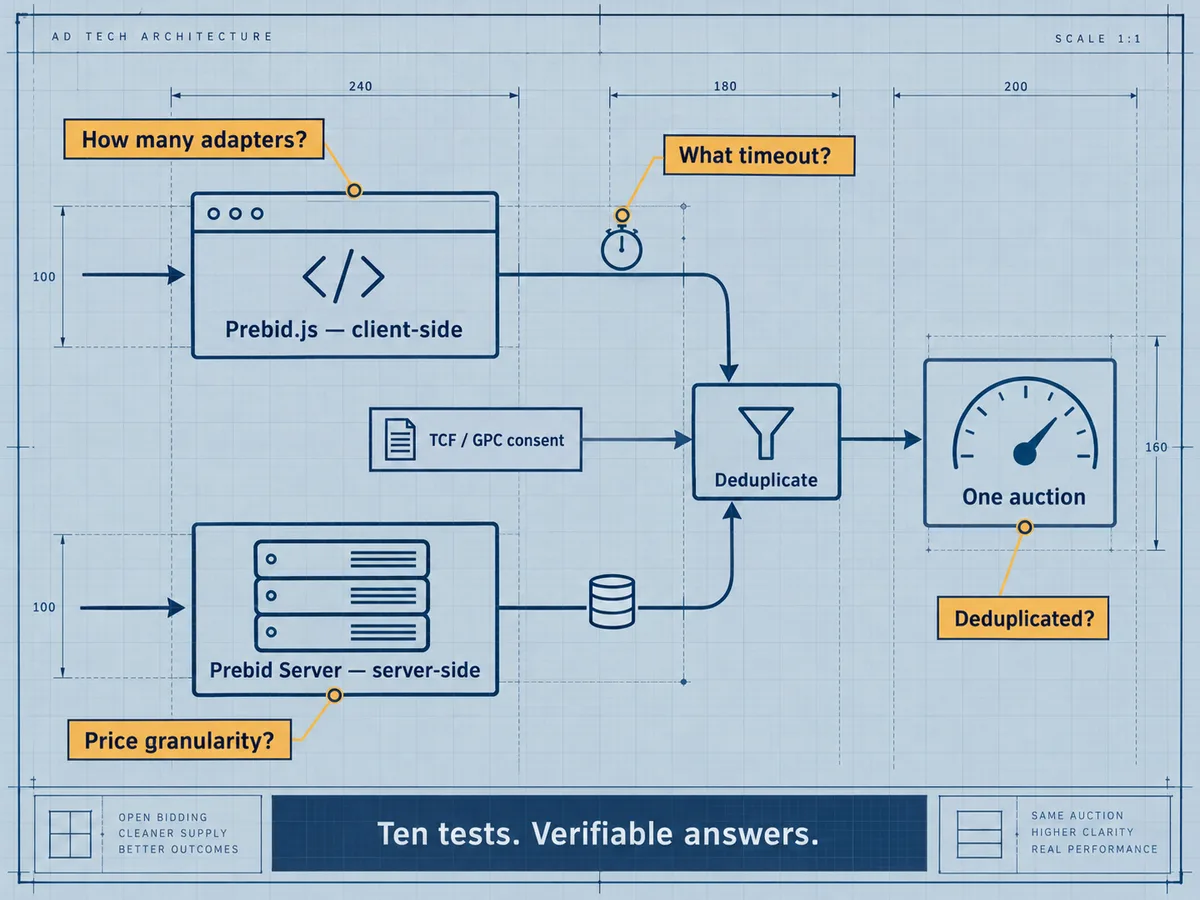
Ask the candidate to describe their header bidding architecture in writing: client-side Prebid.js, Prebid Server, or a hybrid, plus the number of demand adapters, the auction timeout, and the price granularity. The answers separate partners who engineer their own stack from resellers who lease someone else's. Prebid.org governs the open-source Prebid standard, and its Prebid.org membership organization roster shows which companies invest engineering in the project rather than merely consuming it.
A serious partner should also explain how they deduplicate demand between client and server auctions, and how they pass consent signals under the TCF framework and Global Privacy Control. Deduplication matters more than adapter count, because the same bid arriving through two paths inflates apparent competition without raising your net revenue. In our case, we combine Prebid and oRTB so a publisher keeps one auction across client-side and server-side demand, and you can inspect the full setup on the WireAds SSP page. The test works for anyone, though: request the adapter list, the timeout default, and the dates of the last three Prebid version upgrades. A partner who cannot name their own timeout setting does not run their own auction.
Test two: demand depth and real auction competition
Ask how many distinct demand sources actually bid on your inventory in your geos and formats, and how many of those represent direct deals versus open market exchanges. Many self-described SSPs aggregate one or two exchanges and resell them at a markup, which means your impression sees fewer bidders and weaker price discovery than a direct integration would produce. Fewer bidders also means less resilience: when one source pauses a campaign, your fill rate drops with no backup demand to absorb the loss.
Ask a sharper follow-up: when open market demand fails to clear your floor, does the impression fall through to a direct agency deal, or does it default to a house ad or blank? We hold direct deals from global and local brand agencies alongside open market demand from exchanges, DSPs and SSPs, and we combine all of it so every source bids against the same impression. That structure matters most on premium placements, where agency demand often outbids open market by a wide margin. Demand depth is measurable, so ask for the average number of bidders per auction and the share of revenue by source type for a comparable publisher. A partner who answers with adjectives instead of numbers has something to hide.
Test three: Google demand access through MCM and Open Bidding
Google demand still anchors pricing in most markets, so ask specifically how the partner accesses it. The correct answer involves a Multiple Customer Management (MCM) relationship that passes revenue transparently to your account, plus AdX and Authorized Buyers demand competing in the auction. Ask whether the partner bids into your Google Ad Manager setup through header bidding, through Open Bidding, or both, and why they chose that split.
Google's Open Bidding integration documentation explains how exchange partners configure Open Bidding on Ad Manager inventory, and a competent partner should discuss the trade-offs fluently: Open Bidding runs inside GAM without adding page latency, while header bidding adds demand outside the GAM auction at the cost of some setup complexity. We run MCM with AdX demand plus our own aggregated stack, which gives publishers Google demand without forcing them to choose between integration paths. If a candidate cannot explain their MCM structure or evades the question of who holds the AdX relationship, treat that as a finding, not a detail. The MCM chain also affects your revenue reporting inside GAM, so ask where the revenue line appears and what the management fee costs.
Test four: supply chain transparency in ads.txt and sellers.json
Transparency has three artifacts, and a partner should produce all of them without hesitation: an accurate ads.txt or app-ads.txt file, a complete sellers.json, and support for the SupplyChain object on bid requests. The IAB sellers.json spec exists so buyers can verify direct sellers versus resellers in the chain, and a partner who resists publishing it is telling you where the margin hides. Ask two direct questions: will our domain appear in your sellers.json as DIRECT or RESELLER, and what rev share does each hop in the chain take?
Then verify the answers yourself against the live files, because sales claims and published artifacts do not always match. We publish our chain because we hold direct relationships with publishers and we want buyers to bid with confidence on that provenance. The SupplyChain object deserves the same scrutiny, since it exposes every intermediary to the DSP on each bid request. Long chains depress bids, because buyers price in the accumulated take at each hop. A partner with a short, clean chain wins auctions you never see, and that difference shows up only in your net line items.
Test five: ad quality filtering and creative standards
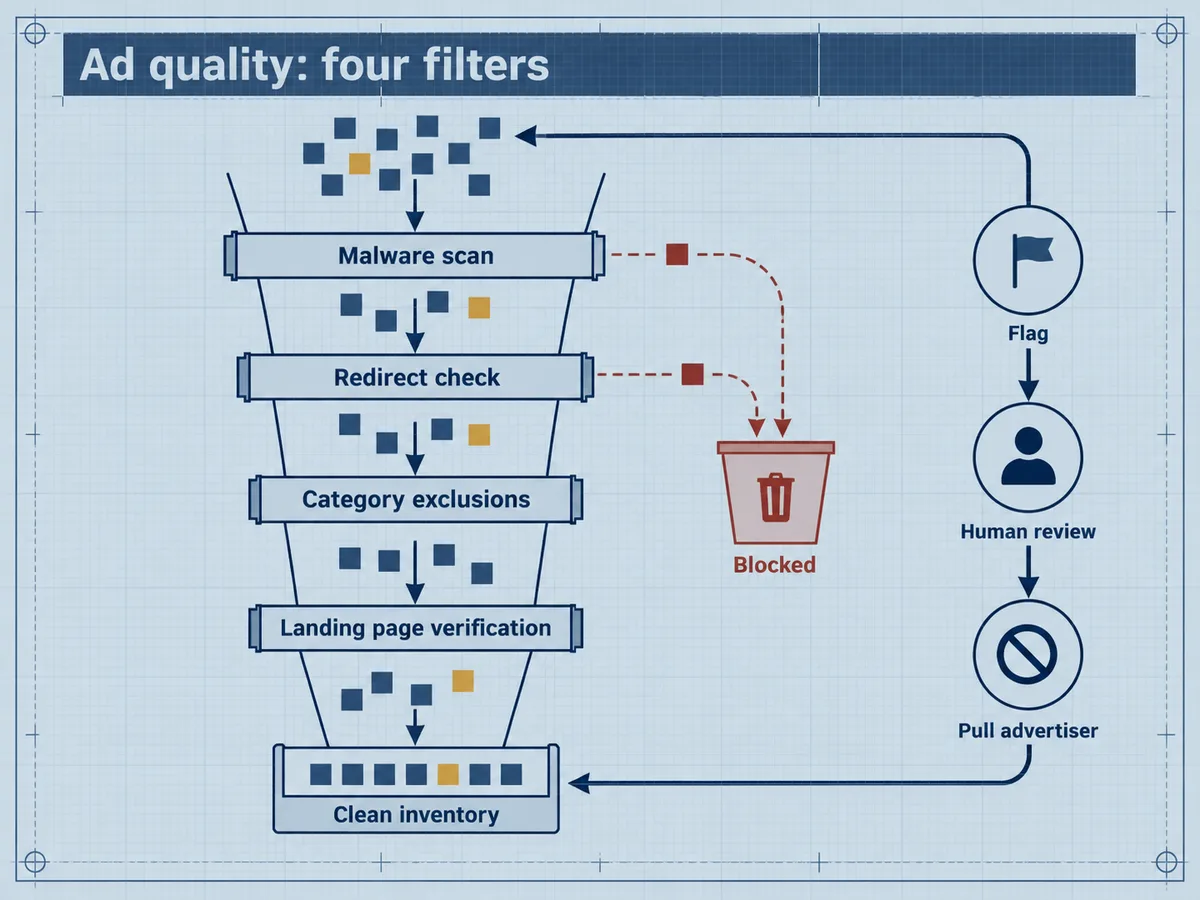
Bad creatives cost more revenue than they earn, because they drive bounce, crush viewability and push readers toward ad blockers. Ask the candidate to describe their filtering stack in specifics: malware and redirect scanning, category exclusions, auto-play audio policies, landing page verification, and how quickly they pull a flagged advertiser. Ask for the escalation path when a malicious creative slips through, including response time commitments and who holds authority to pause a demand source.
We source demand from premium partners that hold the highest quality standards for brands, and we apply strict filtering of unwanted ads before anything reaches publisher inventory. That costs us some fill rate on occasion, and we accept the trade, because a publisher's repeat-visit economics matter more than any single impression. The test for any partner: request their ad quality policy in writing and the name of the team that enforces it. A policy that lives only in a sales deck does not exist. Also ask how they handle report volume, since a publisher flagging five bad creatives per week should get a human response, not a ticket number.
Test six: floor price strategy and fill rate honesty
Ask how the partner sets price floors: static, per-geo, per-format, or dynamic based on historical bid data. Then ask what fill rate they typically deliver at those floors, because CPM and fill pull against each other and a dishonest quote inflates one while hiding the other. A partner claiming both 100 percent fill and top-of-market CPMs usually quotes gross numbers before defaults, redirects and unsold fallbacks.
We manage floors per geo and format, and we would rather report a real fill rate than a padded one, because net revenue is the only number that reaches your bank account. Ask for the math: estimated impressions, cleared impressions, and average net CPM for a site comparable to yours. Reputable partners answer with ranges and mechanisms rather than guarantees, and you should distrust anyone who promises exact figures before they see your traffic. Also ask who owns floor changes, you or the partner, and how quickly changes take effect. A partner who needs two weeks to adjust a floor cannot respond to a demand dip.
Test seven: format and channel coverage across web, app and CTV
Ask whether the partner's demand actually bids on your specific format mix, or whether their rate card describes inventory you do not have. The formats that matter depend on your property: display, video, native, sticky anchors, interstitials, and on CTV or OTT platforms, VAST-tag video demand. The same question applies to channels: a partner strong on web display may carry no meaningful app or CTV demand, and a blended quote will hide that gap until your first payment report.
Our WireAds ad format library lists what we serve across web, app and CTV/OTT, and we encourage publishers to test the specific formats they run rather than accept a blended CPM. The test: request a per-format breakdown of fill and CPM for your top geos. If a partner can only quote one blended number, they do not know their own demand well enough to manage your inventory. For video specifically, ask about VAST version support and pod configuration, because mismatched tag support produces unfilled slots that look like demand weakness on your side.
Test eight: geographic demand coverage
Ask for revenue share by country for a publisher with your traffic profile, then compare it against a blended global quote. Global averages hide the fact that demand quality swings hard by market: tier-one geos clear easily, while smaller markets depend on local agency relationships and local DSP presence. A partner can look excellent on US traffic and still underperform badly in Southeast Asia or Latin America.
We work globally with every country that has Google monetization, and we hold direct deals from both global and local brand agencies, because local agency demand frequently outbids open market demand in mid-tier geos. If your traffic concentrates outside North America and Western Europe, the local-demand question becomes the single most important one on this list. A partner without local relationships in your markets will clear your inventory at open market rates, which typically sit well below what a direct local campaign pays. Ask for two reference publishers in your primary market, and check that their traffic profile resembles yours before you trust the numbers.
Test nine: payment terms, fees and reporting granularity
Ask for payment terms in writing: net payment period, minimum payout, payment methods, and the exact definition of the revenue line, gross or net of their fees. We pay Net 30 on a CPM basis, and we state that up front because payment terms reveal how a partner treats the relationship. A 60 or 90 day net term, or a vague fee structure, shifts working capital risk onto you and often signals thin margins elsewhere in the chain.
Reporting deserves equal scrutiny: ask whether you can break revenue down by placement, country, format and device, and how often the data refreshes. Granular reporting lets you act, for example by moving a format or adjusting a floor on a specific geo. Blended dashboards look clean and tell you nothing. Details of our terms and reporting sit on the WireAds for publishers page, and the test for any candidate is simple: everything they promise about money should appear in a contract, not a chat message. Ask also about clawback or adjustment policies, because some partners reconcile revenue downward months later, and you should know that risk before it lands on an invoice.
Test ten: onboarding, support and escalation paths
Ask who runs your account after the deal closes. The questions that matter: is there a named account manager, what is the technical escalation path, who sets up GAM line items if you need help, and what is the typical integration time from contract to first revenue. Onboarding friction costs real money, because every day of unfilled inventory is gone permanently.
Ask for a reference publisher with a similar profile and actually contact them. We staff support with practitioners who configure Prebid, GAM and MCM integrations daily, and we would rather prove that on a call than describe it in a proposal. Support quality rarely appears in a rate card, yet it determines how fast you recover when a demand source drops or a creative breaks a layout at 2 a.m. Time the candidate's response to your questionnaire itself, because pre-sales responsiveness predicts post-sales responsiveness with uncomfortable accuracy. A partner who takes two weeks to answer ten written questions will take longer when revenue depends on the answer.
How to run the ten tests fairly
Run the ten tests as a structured evaluation, not as a series of sales calls. Send every candidate the same written questionnaire covering the ten items, score the answers, and then verify the claims you can verify independently: live ads.txt and sellers.json files, MCM structure, and Prebid version history. For the finalists, design a split test. Split traffic 50/50 by user or by session, hold floors and formats constant, run each configuration for at least 30 days to absorb weekly seasonality, and measure net revenue per thousand sessions rather than gross CPM.
Gross CPM comparisons mislead, because fill, defaults and fee chains differ between partners. Compare like inventory against like: same geos, same formats, same time windows. Document everything, because the results become your baseline for the next negotiation cycle and your evidence if a partner disputes the outcome. If you want to run these tests against us, request a WireAds review and we will answer all ten questions in writing before you send a single impression. That is the standard we hold ourselves to, and it is the standard any premium publisher should demand from every platform on the shortlist.