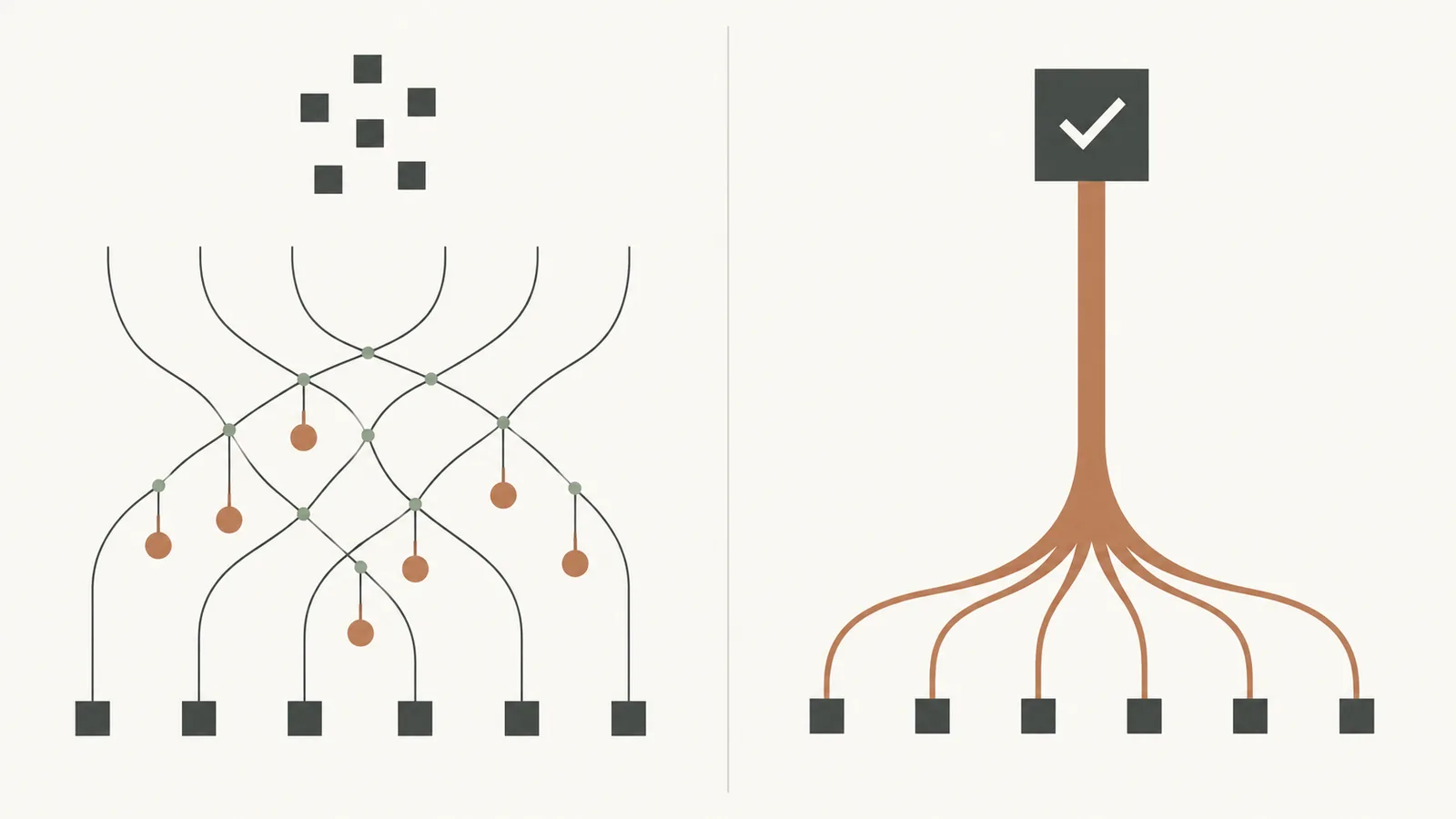
A publisher running six SSP connections does not run six auctions. It runs six partial auctions, each with its own fee stack, its own identity syncs, and its own view of the same impression. The buyers behind those SSPs overlap far more than most stacks admit, so the sixth connection rarely adds new demand. It adds cost, latency, and reporting noise. This article makes the consolidation case with mechanisms you can verify in your own account, and it uses our single-auction model at WireAds as the worked example.
Every Hop in the Supply Chain Takes a Cut
Most intermediaries in the programmatic chain charge a revenue share rather than a flat fee. Each hop between the buyer and your inventory keeps a percentage, and those percentages compound. Three hops at 15 percent each leave roughly 61 percent of the original bid. A buyer willing to pay $4.50 CPM can show up in your report near $2.76 after three intermediaries take their share. When you run five SSPs, you pay five separate fee stacks on demand that overlaps heavily across them.
The fee is only the visible cost. Each SSP also maintains its own user ID syncs with the same DSPs. Match rates differ per sync, so a buyer that recognizes a user through one SSP's sync bids with confidence there and bids blind, or not at all, through the others. Fragmented identity pushes spend toward whichever sync happens to work, not toward the path that serves you best. Consolidating demand into one auction lets a buyer sync once per impression context and bid at full strength everywhere.
Latency compounds the same way. A header bidding wrapper with a 1000 ms timeout must call every connected SSP, and each connection adds its own request and response time. Bids that land after the timeout vanish from the auction. As you add connections, average response time creeps up, timeout rates climb, and the wrapper carries fewer bids into the final competition. Slow paths also drag page performance, which lowers viewability, which lowers what buyers will pay for your inventory in the next auction.
Finally, each SSP applies its own first-price logic. Bid shading algorithms estimate the second price under uncertainty, and none of them sees the full bid field. Six SSPs shade six different ways, and you inherit six sets of estimation errors instead of one. In video and CTV/OTT the problem grows: VAST wrappers chain tags, and each chained tag adds another fee, another timeout budget, and another point where the creative can fail.
More Bidders Is Not More Competition
Header bidding wrappers typically accept one bid per SSP per slot, regardless of how many buyers sit behind that SSP. Ten connected SSPs with heavy buyer overlap produce roughly the same effective competition as three SSPs with distinct demand. The publisher auction does not count buyers. It counts returned bids, and it prices the impression against the second-highest relevant bid it can see.
Bid density, not bidder count, sets price in a first-price auction. Consider two stacks. Stack A runs one auction and returns bids of $4.10, $3.95, and $3.90. Stack B runs six partial auctions whose top bids come in at $4.00, $3.40, $3.20, $2.90, $2.75, and $2.60. Stack A clears close to $4.00 because the winner must beat a near rival. Stack B clears around $3.45, pays six fee stacks to do it, and reports six "competing" bidders. Concentrating demand in one auction, where every buyer sees the same impression, the same identity, and the same timeout, builds the deep bid field that actually moves price.
The same DSP often buys through several SSPs at once. Your reporting then shows six bidders, but two buyers may account for most of the spend across all six paths. Apparent competition inflates while real competition stays flat and your fee bill multiplies. Marginal returns drop sharply as the stack grows: the second quality SSP usually adds real demand, and the fifth or sixth mostly resells buyers you already reach.
This is the core tension of consolidation. Adding an SSP feels like adding competition, and it sometimes is. But past a small number of distinct demand sources, each addition mostly duplicates existing buyers, adds a fee stack, fragments identity, and slows the auction. The honest question for every new connection is not "does it bid?" but "does it return bids that clear the price the existing auction already sets, after fees?"
Audit Your Demand Paths Before You Cut Anything
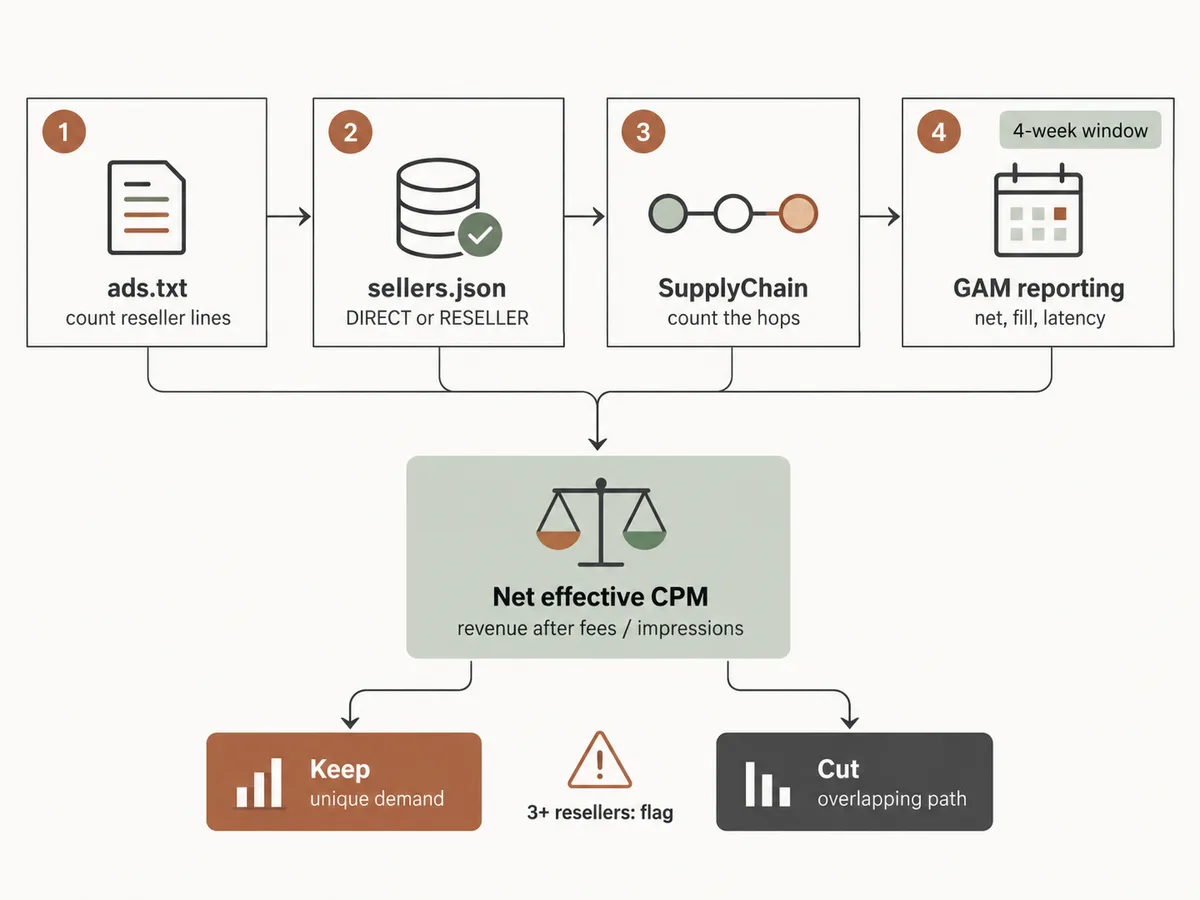
Consolidation decisions should rest on data you already have or can request within a week. Four artifacts tell you who sells your inventory, through whom, and at what net value.
- ads.txt: count your reseller lines. Each line declares one selling path, and a file that keeps growing usually signals intermediaries stacking on top of each other.
- sellers.json: use it to audit partners with sellers.json, because it lets you verify every intermediary and its direct-versus-reseller role before you decide which paths carry real demand.
- The SupplyChain object: check whether your partners populate it. For SupplyChain object path transparency, bid requests can expose the full reseller chain, which shows the actual hops behind each bid rather than the hops your ads.txt declares.
- Ad Manager reporting: net revenue, fill rate, and latency per demand path, split by geo and format, over a stable four-week window.
Read the sellers.json entries against your ads.txt lines. An entry marked direct means the seller owns the inventory relationship. An entry marked reseller means someone else's inventory flows through that seller, and every additional reseller in the chain is another fee and another failure point. When you find chains of three or more resellers behind a single line, flag them: those paths bid last, pay least, and time out most.
Then do the arithmetic. Compute net effective CPM per path: revenue after all fees divided by impressions served. Measure buyer overlap between paths, timeout rates per path, and fill per geo and format. Paths that clear your net CPM bar and add demand you cannot reach elsewhere stay in the stack. The rest are consolidation candidates, and you now have the receipts to prove it.
One Auction, One Fee Stack: The Single-Auction Model
The consolidation endpoint is a single auction where all demand competes at once. We run that model at WireAds. Our unified auction platform brings Prebid, Prebid Server, OpenRTB demand, Google Ad Exchange access through Google MCM, and direct deals from global and local brand agencies into one auction for every impression.
Google Ad Manager makes the same structural argument from its own side. With an Open Bidding single connection, many exchanges compete through one server-to-server connection, which cuts latency and removes duplicate call paths. Publisher-side consolidation achieves the same effect from the opposite direction: you collapse your outbound connections instead of Google collapsing inbound ones.
Because all demand bids in one place, the auction sees true bid density. Buyers compete against each other rather than against fragmented partial auctions, and the winner pays against a real second bid instead of a shaded estimate. You pay one fee stack instead of five. Identity syncs happen once per buyer per impression context rather than once per SSP. Every bid in the auction faces the same timeout, so no path wins by being fast and thin.
The MCM piece matters for scale. Under Google Multiple Customer Management we monetize publisher inventory through our own Ad Manager accounts, which gives publishers access to Google Ad Exchange demand alongside our Prebid and OpenRTB demand without a separate integration to maintain. Direct deals from brand agencies bid in the same auction as open market demand, so agency budgets compete with exchange budgets instead of fragmenting across separate tags and separate floors.
We also hold the demand itself to a standard. Our ad sources are premium and we filter unwanted ads strictly, because consolidation concentrates your revenue in fewer paths and raises the stakes on creative quality. We work CPM-based, we pay Net 30, and we operate globally across web, app, and CTV/OTT in every country where Google monetization is available. One auction, one fee stack, one payment terms sheet, and one reporting view you can reconcile line by line.
Migrate Without a Revenue Dip
Consolidation fails when a publisher cuts every path at once and hopes. A staged migration protects revenue while you gather the evidence that justifies each cut.
- Baseline for four weeks: net eCPM, fill rate, viewability, and timeout rate per path, per geo and format. Gross CPM flatters weak paths, so baseline on net numbers only.
- Parallel run: connect the consolidated auction alongside your existing paths and compare like for like, same floors, same formats, same geos.
- Cut one path at a time: remove the weakest path by net eCPM first, then re-baseline for two to three weeks before touching the next one.
- Map floor prices across: carry your price floors per size, geo, and format into the consolidated auction so buyers see consistent price signals and your historical data stays comparable.
- Watch the right metrics: net eCPM after fees, fill per geo, timeout rate, and buyer overlap. If net eCPM holds or rises while the path count falls, the migration is working.
Our monetization services team runs this sequence with publishers: baseline, parallel run, staged cutover, and reporting on net numbers throughout. Done this way, consolidation typically holds or raises net revenue within one to two payment cycles, because savings on fees, identity, and latency offset the loss of any single weak path. The paths you keep should earn their place with unique demand, not with tenure.
Questions to Ask Before You Consolidate
Consolidate into one auction or trim a stack from eight paths to three: either way, ask every remaining SSP the same questions and compare the answers on paper, not on promises.
- Do you report net or gross revenue, and can you show fee deductions per path?
- Do you publish sellers.json, and does every entry match a line in your ads.txt?
- Do your bid requests carry the SupplyChain object, and will you show us a sample?
- What share of your demand is direct rather than resold through other intermediaries?
- Can we access log-level bid data to verify performance independently?
- What are the payment terms, thresholds, and the settlement schedule?
We answer all of these openly. We publish sellers.json, we support the SupplyChain object, we report net, and we pay Net 30 on CPM-based terms with no hidden deductions. Our demand combines exchange, Google Ad Exchange through MCM, and direct agency deals, and we filter it for brand quality before it ever reaches your inventory. If you want to run this audit against your current stack, WireAds support will walk through your ads.txt, sellers.json, and path-level reporting with you, line by line.
Fewer SSPs, chosen on evidence, means fewer fees per impression, one identity sync per buyer, one auction with real bid density, and reporting you can reconcile against your own logs. That is the mechanism by which less becomes more programmatic revenue, and every piece of it is verifiable before you commit.