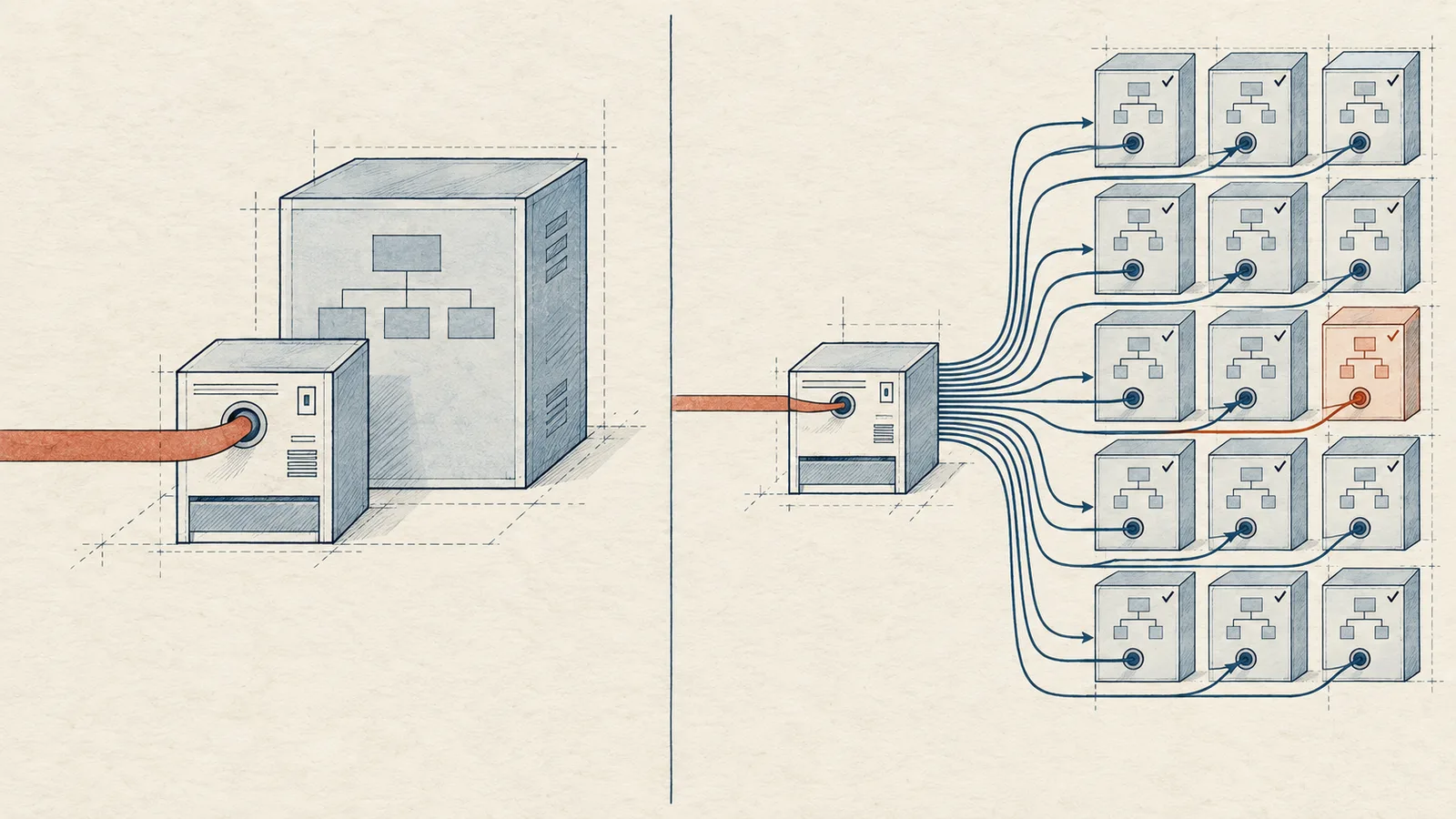
Google Ad Exchange consistently clears some of the highest CPMs in open market programmatic, yet a publisher cannot simply open an account the way one signs up for an ad network. Google restricts direct AdX access to companies that meet steep traffic minimums, operational requirements and infrastructure standards. Multiple Customer Management, or MCM, solves this gap: a certified parent account takes on your inventory, and premium Authorized Buyers demand starts bidding on your impressions through that relationship. This article explains how the delegation mechanism works, what revenue uplift you can realistically expect, and how we onboard publishers into our own MCM program at WireAds.
What Multiple Customer Management Actually Does
Multiple Customer Management is Google's formal framework for a scaled publisher partnership. A parent account, typically a large publisher group, an SSP or a technology partner, holds the direct AdX relationship and manages inventory on behalf of child accounts. Google's own documentation on About Multiple Customer Management describes the program clearly: third-party providers consult, represent and manage inventory for publisher revenue. The child publisher keeps ownership of the inventory and the content, while the parent handles the technical integration, the payment flow from Google and the account management overhead.
The structure exists because Google cannot support hundreds of thousands of small and mid-sized accounts individually. MCM lets Google consolidate that long tail through vetted partners who carry responsibility for policy compliance, traffic quality and financial settlement. For the child publisher, the arrangement converts an inaccessible demand source into a working one without building an entire ad operations organization.
Two delegation modes exist within MCM: Manage Revenue and Manage Inventory. Manage Revenue keeps the child's own Google Ad Manager account in place, and the parent only attaches its payment relationship to that account. Manage Inventory goes further, and the parent runs the child's inventory inside the parent's own GAM environment. Most mid-sized publishers working with an SSP partner end up in Manage Inventory, because the parent can then apply its full stack: Prebid, header bidding configuration, floor prices and deal packaging. That is also the mode we use at WireAds, and the rest of this article focuses on it.
Why Direct AdX Access Stays Out of Reach for Most Mid-Sized Publishers
The threshold problem is structural, not a matter of negotiation. Direct AdX relationships require sustained, high-volume traffic, a track record of policy compliance at scale, dedicated ad operations staff and often an ads.txt and sellers.json setup that proves a clean supply chain. A publisher doing 5 to 50 million monthly pageviews rarely meets all of those bars at once, and even those that qualify often find the operational burden uneconomical. Running an AdX relationship well means managing line items, monitoring bid distributions, chasing discrepancies and handling payments from Google directly.
There is also a demand quality argument. AdX aggregates Authorized Buyers: large agencies, brand trading desks and premium programmatic buyers with strict brand safety requirements and high CPM budgets. These buyers concentrate their spend through a limited number of trusted supply paths. A small publisher appearing in sellers.json with no history, no managed chain of accountability and no one vouching for the inventory attracts thin bidding. The same inventory, presented under an established MCM parent with a documented supply chain, attracts real bid depth.
The economics compound the problem. Open market CPMs for standard display range widely, typically from well under a dollar in low-value geos and formats to several dollars in premium contexts. The difference between shallow demand and deep demand on the same impressions often shows up as a 30 to 80 percent gap in effective CPM, depending on geo, format and vertical. Mid-sized publishers lose that gap silently, because they never see the bids they missed.
How Manage Inventory Delegation Works
In Manage Inventory mode, the child publisher stops trafficking ads through its own GAM account for the delegated inventory. Instead, the parent creates a child network within its own Google Ad Manager structure. Google's documentation on How Manage Inventory works confirms the core mechanism: parents manage child inventory within the parent account. The parent builds ad units, generates tags, sets floor prices, configures Prebid.js or Prebid Server, and attaches its AdX line items to the child's inventory.
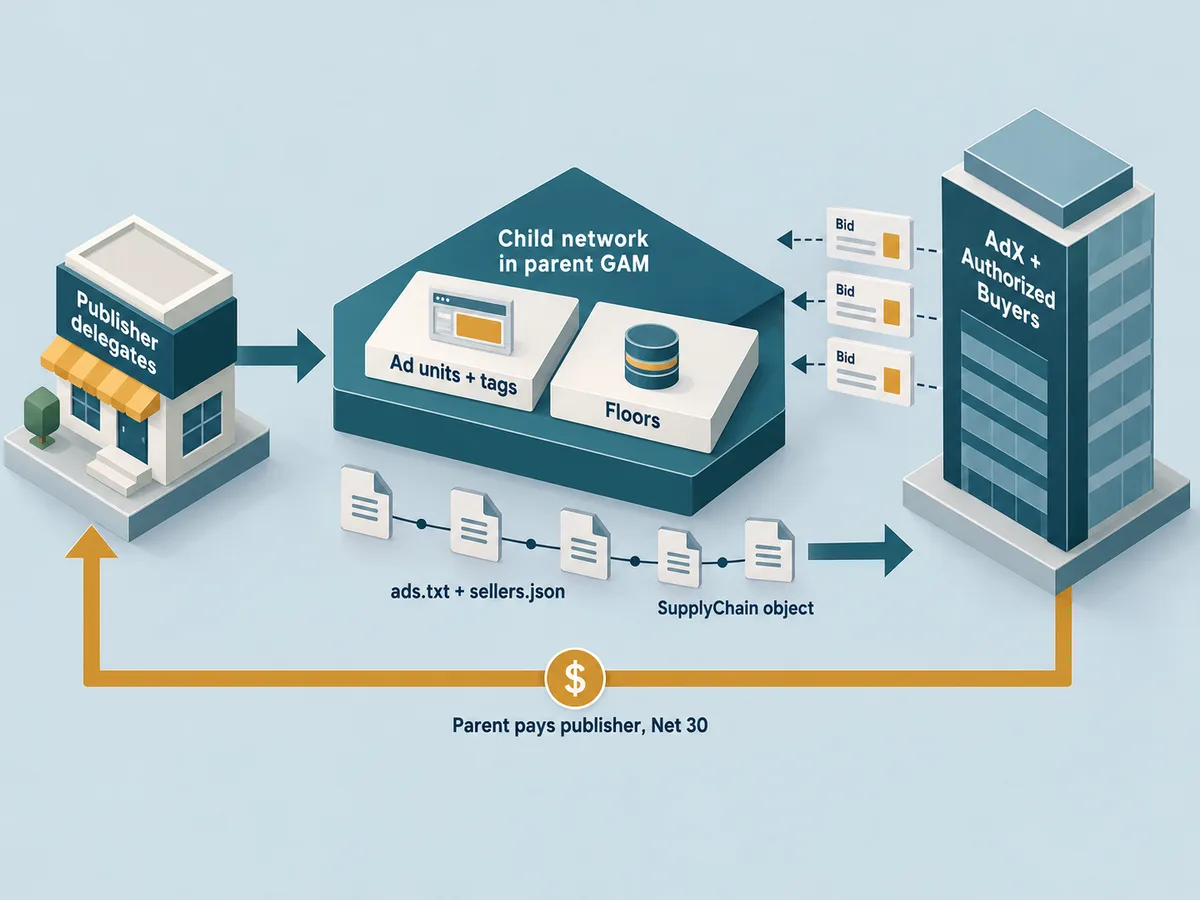
The supply chain documentation follows the delegation. The child publisher adds the parent's entries to its ads.txt file, the parent lists the child in its sellers.json, and every bid request carries a SupplyChain object showing the complete reseller path from the child publisher through the parent to Google. This chain is what Authorized Buyers see, and a complete, consistent chain is what makes them bid without discounting for opacity. We treat ads.txt and sellers.json hygiene as a hard prerequisite in every onboarding we run, because a single mismatched entry suppresses demand across the whole account.
Payments flow through the parent as well. Google settles with the parent account, and the parent pays the child according to the agreed revenue share and payment terms. This is where partner selection matters enormously. Some MCM parents pay Net 60 or later, deduct opaque fees, or bury the revenue share in reporting that the child cannot reconcile. We pay Net 30, we state the revenue share up front, and we give publishers transparent reporting they can check against their own analytics.
The technical integration itself is usually light. The child places the parent's ad tags or the parent's Prebid configuration into its pages, removes conflicting tags, and validates the setup with test traffic. Most mid-sized publishers complete the tag swap and ads.txt update within one to two weeks, and inventory goes live in stages so both sides can monitor fill rates, viewability and error rates during rollout.
What Premium Demand Actually Means in Practice
Premium is not a marketing label; it names a specific bidding population. Google's documentation on Ad Exchange line items states the mechanism plainly: Authorized Buyers and open auction demand bid to monetize otherwise unsold space. Authorized Buyers include major brand budgets with quality floors: they filter aggressively against malware, misleading creatives, low viewability and disallowed content categories. The result for the publisher is fewer but higher-value ads, and importantly, fewer incidents that damage user trust.
This is where the parent's filtering work pays off. We run strict creative and advertiser quality controls on our demand stack before impressions ever reach a publisher page. Unwanted categories, heavy interstitials, auto-redirecting creatives and low-quality advertisers get filtered at the SSP layer. Premium buyers notice this: they bid more confidently on supply that carries a reputation for clean ads, and the effect compounds over time as the publisher's inventory builds a performance history.
The demand mix also matters. AdX rarely works best alone. In our stack, AdX and Google MCM demand compete in the same auction as OpenRTB demand from exchanges and DSPs, Prebid header bidding demand, and direct deals from global and local brand agencies. All demand bids against the same impression, and the highest bid wins. This competition is what lifts effective CPMs: a single demand source has no pressure to bid above the floor, while a crowded auction forces every bidder to show its real ceiling.
Realistic Expectations for Revenue Uplift
Honest numbers first. A publisher moving from a basic ad network or a thin AdSense setup to a well-run MCM relationship with full header bidding typically sees meaningful improvement, but the range is wide. Publishers with good traffic quality, decent viewability and under-monetized inventory often see effective CPMs rise by double-digit percentages. Publishers already running a tuned setup with multiple demand partners see smaller incremental gains, sometimes only in specific geos, formats or dayparts. No partner can promise specific revenue figures, and you should treat any such promise as a red flag.
The uplift mechanism is concrete and worth understanding, because it tells you where your own gains will come from:
- Bid depth: more bidders per impression raises the winning bid above the floor more often.
- Geo coverage: demand that ignores small markets through direct channels often bids through an MCM parent with consolidated volume.
- Format expansion: video via VAST, native and app inventory gain access to demand pools that basic display setups never touch.
- Floor optimization: a parent managing thousands of accounts can price floors against real bid distributions instead of guesses.
Where gains disappoint, the cause is usually on the publisher side. Traffic with low viewability, heavy bot filtering, thin content or poor engagement suppresses bids regardless of who manages the inventory. MCM delegation improves demand access; it does not convert weak inventory into strong inventory. Publishers with 40 percent viewability should fix viewability before expecting demand quality to rescue revenue.
Payment terms deserve equal weight with CPMs. A partner paying Net 30 with a clear revenue share can beat a partner offering nominally higher gross CPMs but paying Net 90 with hidden deductions. Model your cash flow on net revenue per thousand impressions, received on time, not on headline gross figures.
The WireAds MCM Onboarding Path
Our onboarding follows a fixed sequence, and we publish it here so publishers know exactly what happens. First, we audit the property: traffic sources, geo distribution, format mix, current demand setup, viewability and content compliance. This audit determines whether the inventory fits our premium demand standards, and it sets realistic CPM expectations by geo and format before anything goes live. Publishers can start this step from the WireAds publishers overview.
Second, we build the inventory structure inside our Google Ad Manager environment. We create the child network, define ad units matched to the publisher's placements, and configure our WireAds SSP stack around them: Prebid, OpenRTB demand, Google AdX and MCM demand, and our direct brand agency deals, all bidding into the same auction. The publisher receives tags and documentation for the ads.txt and app-ads.txt updates, including the SupplyChain entries that make the supply path fully transparent to buyers.
Third, we run a staged launch. A share of traffic moves first, typically 10 to 20 percent, while both teams monitor fill rate, CPM by geo, viewability, latency and error rates. We compare results against the publisher's previous baseline. Once the numbers hold up, we ramp to full traffic. Most properties complete the full ramp within two to four weeks of signing.
Fourth, we settle. We pay Net 30, with reporting granular enough to reconcile against the publisher's own analytics. Ongoing, our ad operations team handles floor price updates, demand quality monitoring and quarterly setup reviews. The publisher keeps running content and audience work, which is where their leverage actually lives. Publishers who want the broader context on how we approach publisher monetization will find our full framework documented there.
What to Check Before You Sign With Any MCM Parent
The MCM model concentrates a lot of control in the parent account, so due diligence matters. Ask these questions before delegating:
- What is the revenue share, stated as a specific percentage, and what does it include?
- What are the payment terms in writing, and does the parent pay Net 30, Net 60 or something slower?
- Does the parent provide transparent reporting you can reconcile against your own data?
- Who owns the ad tags and the GAM configuration if you leave, and can you export your setup?
- Does the parent filter demand quality, or does it accept everything and let bad creatives through?
- Is the parent's sellers.json and ads.txt guidance complete and consistent with the SupplyChain object?
A parent that answers these questions precisely is operating a real business. A parent that answers with vague promises about "maximized revenue" is telling you something too.
Common Delegation Mistakes to Avoid
Three mistakes recur constantly. The first is leaving old tags in place during migration. Competing tags fragment the auction, cause double counting and depress CPMs on both the old and new setup. Cut over cleanly, placement by placement.
The second is neglecting ads.txt after launch. When a parent adds new demand partners or changes its supply chain, the child's ads.txt file must reflect those changes or the new demand silently fails to serve. We handle this proactively for our publishers, but if you work elsewhere, verify the file every quarter.
The third is treating delegation as a finished project. Demand mixes shift, floor prices drift out of date, and new formats open new demand pools. The publishers who sustain high CPMs review their setup quarterly, test format changes and keep their viewability climbing. The MCM parent should drive this work; if it does not, the parent is collecting a revenue share without earning it.
MCM delegation gives mid-sized publishers a legitimate, transparent path to premium AdX demand that direct access rules would otherwise deny them. The mechanism is proven, the supply chain is documented, and the uplift is real when the underlying inventory deserves it. Choose a parent that pays fast, reports honestly and filters demand hard, then hold up your side of the bargain with quality traffic and clean integration.