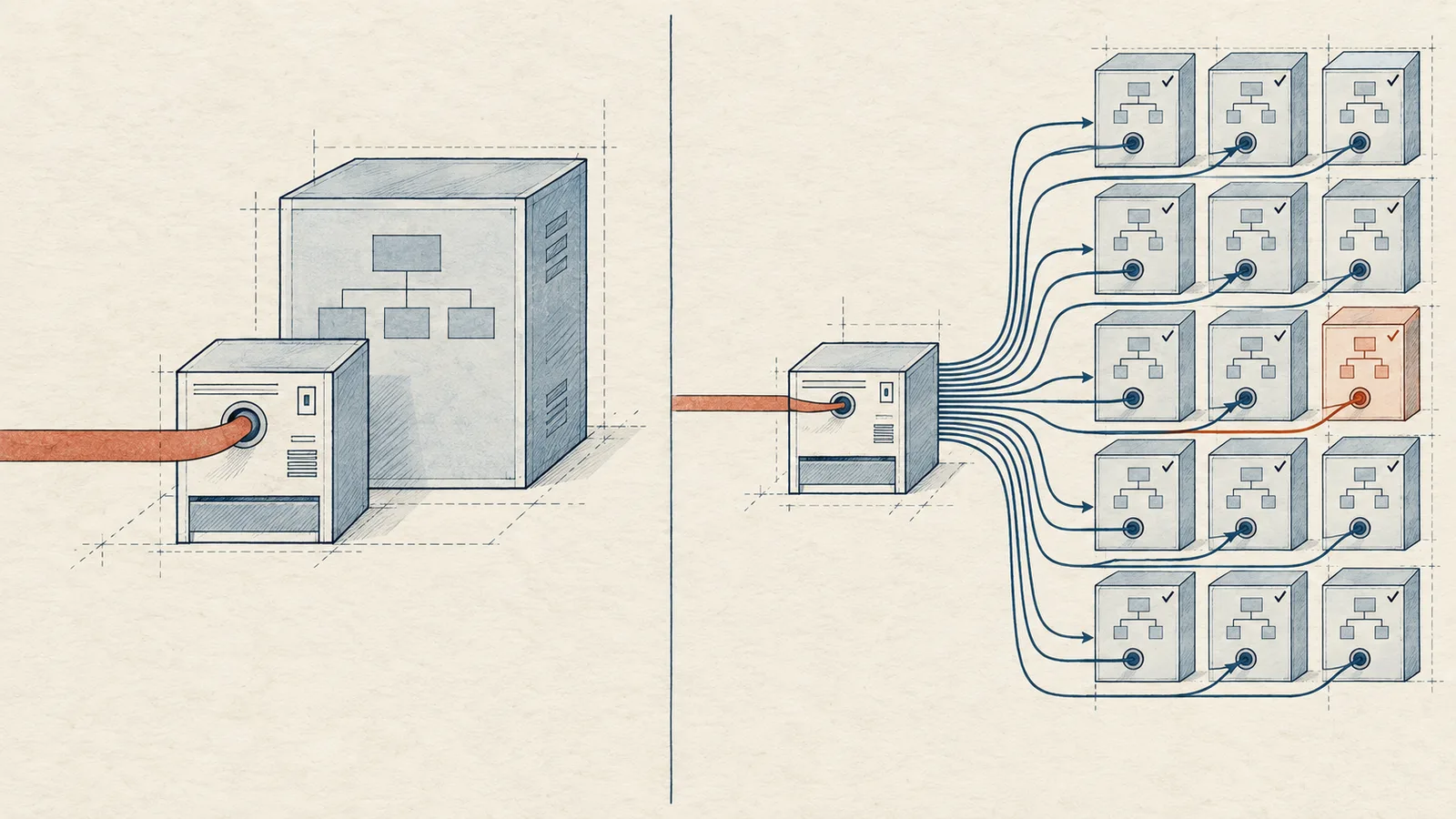
One parent with edit access inside your account, or up to fifteen parents bidding on the same impression: that is the choice at the center of Google's Multiple Customer Management framework. MCM defines how one Google Ad Manager account, the parent, monetizes inventory owned by a second account, the child. Google splits the relationship into two modes, Manage Account (MA) and Manage Inventory (MI), and the mode you sign decides who traffics your inventory, who pays you, and how many demand partners can compete per impression.
Google's About Multiple Customer Management page draws the line precisely. An MA parent manages inventory inside the child account, an MI parent manages it in the parent account, and one child can hold a single MA parent alongside up to 15 MI parents. That final number turns MCM from an account administration detail into a demand strategy decision, and it is the number most publishers underestimate.
What MCM delegates, in plain terms
Multiple Customer Management replaced Google's older top-level domain delegation model and formalized a relationship that ad networks and supply-side platforms have long run informally: a specialist partner monetizes a publisher's inventory at scale. The child keeps its own Ad Manager account, its own network code, and its own logins. The parent, typically an SSP, an ad network, or a managed service, links to that child through a delegation that both sides must approve.
Google reviews the parent before the relationship goes live, because MCM opens the parent's demand connections to the child's inventory. Those connections usually include Authorized Buyers access through Google Ad Exchange, plus whatever OpenRTB and direct demand the parent has assembled. Once Google validates the relationship, the child's inventory can monetize through the parent's stack.
The framework also makes the chain machine-readable. sellers.json records who sells what, ads.txt and app-ads.txt declare the authorized sellers on your domains and apps, and the SupplyChain object attached to each bid request lets a buyer trace the path from your inventory to the final demand source. Both modes produce this traceability; they differ in where the actual work happens.
MA puts the parent to work inside the child's Ad Manager. MI puts the child's inventory to work inside the parent's Ad Manager. Payments, reporting, access control, and the number of partners you can run all follow from that single distinction, so each mode deserves a close look.
Manage Account: one partner inside your Ad Manager
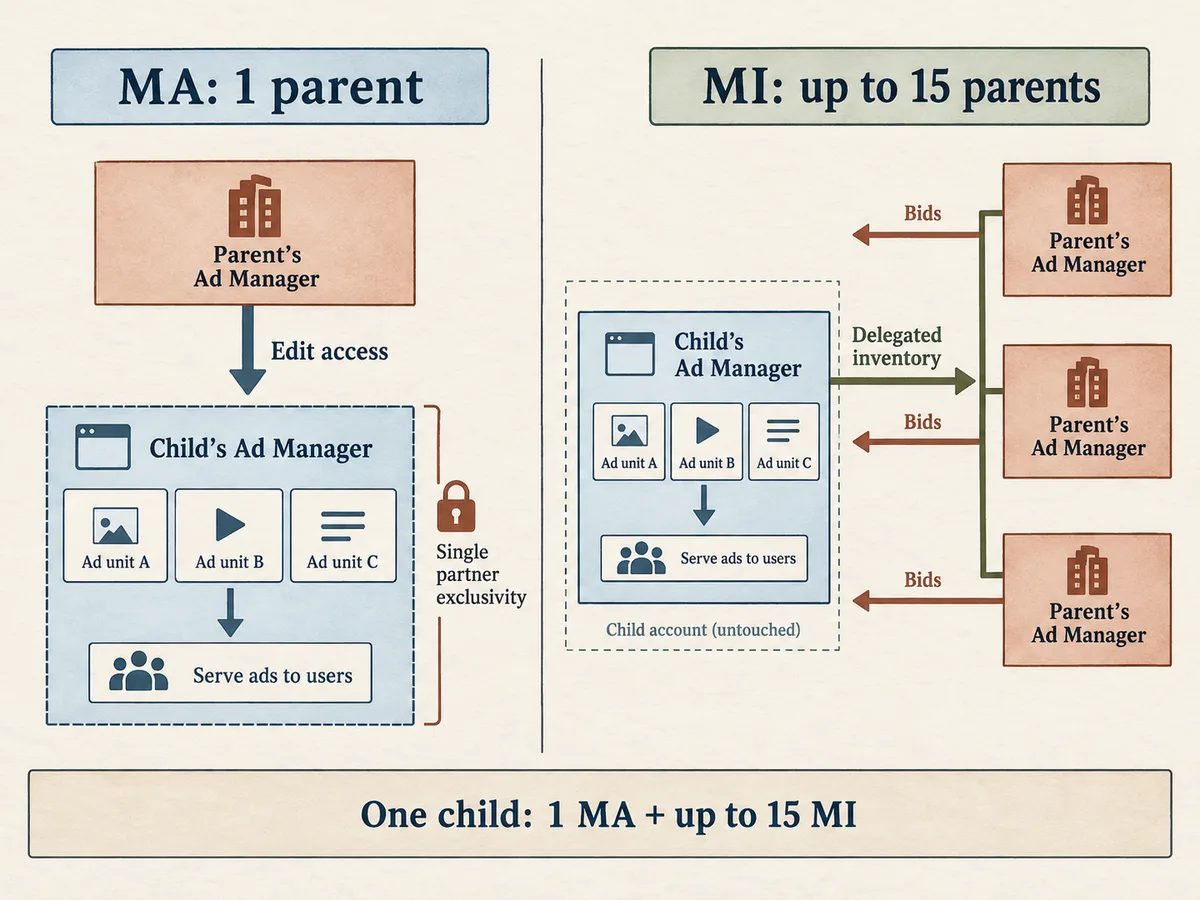
In a Manage Account relationship, the parent receives edit access to the child's Ad Manager account. Google's About Manage Account delegation documentation describes the scope directly: the parent signs in to the child account, creates ad units, orders, and line items, adjusts delivery and pricing settings, and runs day-to-day ad operations under the publisher's network code. Only one MA parent can exist per child, so the arrangement locks the publisher to a single operating partner.
MA has genuine advantages for publishers without ad ops capacity. The parent brings trafficking discipline, campaign management, and optimization practice, and the publisher sees results inside their own account rather than through a partner dashboard. Because inventory serves from the child account, earnings accrue there, and Google pays the child directly. For a small publisher, that combination of hands-on management and direct payment simplifies operations considerably.
Google scopes the access: an MA parent manages inventory, orders, and creatives, but your payment profile and your user administration stay with you unless you grant more. The practical risk is less about bad intent and more about drift. Two teams editing the same account produce naming conventions nobody follows and line items nobody owns, so publishers who run MA well define an ownership boundary in writing: which ad units the parent touches, which reports it owns, and when it must consult you.
The cost sits inside the same sentence as the benefit. One MA parent means one demand stack, one pricing policy, and one negotiation table. If that partner's CPMs soften in a given geo or format, no second bidder inside the framework catches the impression, because Google permits no second MA parent. The publisher's leverage reduces to the renewal date.
MA also hands a partner structural influence over your account. Renamed ad units, restructured targeting, and changed delivery settings all happen inside your account, under your network code, and they persist after the relationship ends. Publishers with in-house ad ops usually reject that trade. Publishers without a trafficker often accept it, which is exactly why both modes exist.
Manage Inventory: your inventory, managed in the parent's account
MI inverts the direction. The child delegates specific inventory, usually named ad units or a defined set of them, to the parent, and the parent traffics against that inventory inside the parent's own Ad Manager account. Google's How Manage Inventory delegation works documentation stresses the boundary: parents access only the inventory you delegate, and your child account stays untouched for serving. Your own campaigns, house ads, and direct orders keep running exactly as before.
Delegation granularity is a publisher decision. You can delegate a single test ad unit, one section of a site, or your full display inventory, and you can scope it by platform, since web, app, and CTV/OTT inventory all travel through the same mechanism. The parent sees and monetizes only what you hand over.
Follow one impression to see the difference in practice. A reader lands on your page, your ad unit calls your ad server, and the delegated slot hands off to the parent's stack, which runs its auction across Google Ad Exchange, OpenRTB demand, and direct deals, then returns a creative. Under MA the same auction would have run inside your account, on line items the parent trafficked there. The reader never sees the difference; your reporting and your invoice do.
Because the inventory monetizes inside the parent account, earnings accrue to the parent, and the parent pays the publisher. Google settles with the parent; your payment terms, minimums, and revenue share live in the contract between the two companies. At WireAds that settlement runs Net 30, and MI is exactly what keeps those terms clean: one Google payment to us, one invoice from us to you.
Why the parent count decides your auction
Fifteen MI parents is not a trivia fact; it is the mechanism that turns MCM into a competitive auction. Under MI, each parent monetizes your delegated inventory inside its own account, with its own demand mix, its own Ad Exchange relationship, its own direct deals, and its own pricing logic. Delegate the same ad units to four MI parents, and four independent demand stacks see the same impression.
The competition itself happens in your header bidding wrapper or your ad server's decisioning. Each MI parent can return a bid into a Prebid auction, Prebid.js on the page or Prebid Server where app and CTV inventory usually lives, and the highest bid wins the impression. One MI parent gives you one price point per impression. Four give you four, and the spread between them is the premium that competition extracts.
Auction math explains why depth pays. Modern programmatic auctions clear at first price, so the winner pays its own bid, and more independent bidders push the expected clearing price up, because a bid that would have won cheaply now risks losing to a competitor with better data for that exact user. This is the same logic that made header bidding the default on the open web, and MI extends it to the MCM relationship itself.
MA cannot replicate this structure. One MA parent means one stack, and a second operating partner is impossible within the mode. A publisher who wants multiple demand sources under MA must route them through that single parent as downstream supply, which means the parent controls allocation, observes every competitor's pricing, and takes margin across the whole chain.
There is a second, quieter consequence. MI parents hold no edit rights to your account, so delegating to several of them creates no governance problem. You can run three MI parents for a quarter, drop the weakest, and add a fourth, all without renegotiating anything with the remaining two. MA relationships unwind far more painfully, because the parent's fingerprints cover your entire account.
None of this makes MI automatically superior. A publisher who wants one accountable operator, and who values that over auction pressure, gets a fair deal from MA. A publisher who wants leverage, price comparison, and a fast exit gets those things only from MI.
Payments, reporting and the audit trail
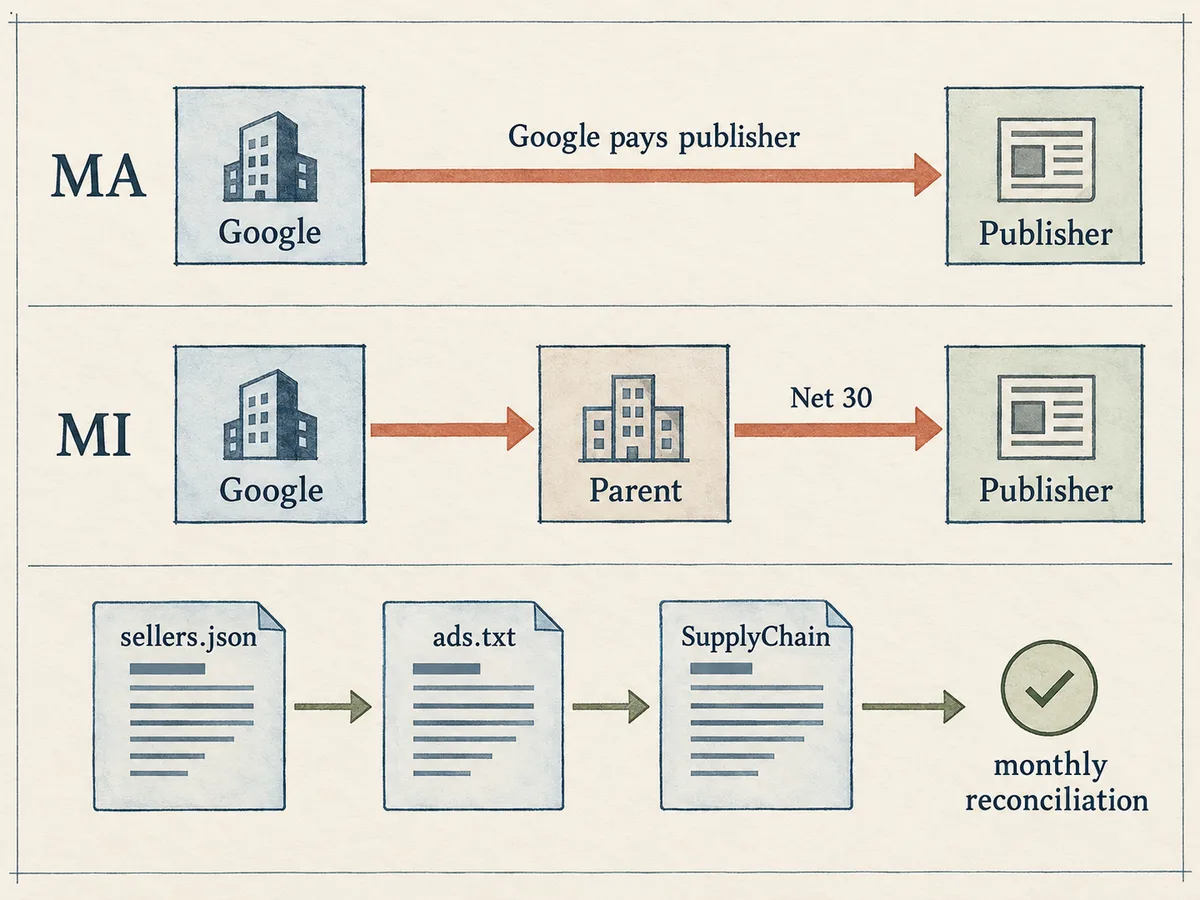
Payment direction follows the account that serves the impression. Under MA, the child account serves and earns, so Google pays the publisher directly. Under MI, the parent account serves and earns, so Google pays the parent, and the parent pays the publisher under contract terms. Both flows are legitimate; they answer different questions about who carries payment risk and who controls cash in transit.
Under MI, your contract with the parent governs everything Google does not: payment schedule, minimum thresholds, reporting granularity, revenue share, and currency. We pay Net 30 and we state the share before you delegate anything, because under MI those terms form the entire commercial relationship, not a footnote to a Google payment.
Reporting splits along the same line. MA parents work inside your account, so your own GAM reports carry the revenue. MI parents report from their side, so you reconcile against the parent's numbers. A serious MI partner gives you delegated-inventory reporting down to the ad unit, broken out by geo, device, and format, not just an invoice total.
Reconciliation deserves a cadence, not an annual audit. Compare the parent's reported impressions against your own GAM delivery numbers monthly, watch for discrepancies above a few percent, and investigate before they compound. Under MI, the parent's numbers are the ones Google pays against, so the burden of proof sits with the parent, and a partner that resists ad-unit-level transparency is telling you something.
The audit trail stays public in both modes. sellers.json lists the parent as the seller of record for your delegated inventory, your ads.txt and app-ads.txt files must stay consistent with it, and the SupplyChain object on each bid request lets any buyer verify the chain end to end. A short, clean chain is a pricing asset: buyers bid with more confidence on supply they can trace.
Common misconfigurations and what they cost
Most MCM problems are configuration problems, not strategy problems. The first is the orphaned delegation: a publisher delegates inventory, the parent never traffics against it, and the ad unit serves a blank or a fallback for weeks. Check delegated inventory in the parent's reports within days of setup, not months.
The second is ads.txt drift. You add an MI parent, the parent's seller IDs change during an account restructure, and your ads.txt still lists the old entries. Buyers then treat the chain as unverifiable and shade their bids. Assign one owner to the file and review it whenever your partner list changes.
The third is double delegation without decisioning: two MI parents both receiving the same call with no auction between them, so the impression goes to whichever loads first rather than whichever pays most. Wire the parents into one decisioning layer, Prebid on the page or Prebid Server for app and CTV, and let price settle it.
The fourth is scope creep in MA: a partner hired to manage display slowly starts editing video, then reporting, then your whole account structure. The fix is the ownership boundary from earlier, written down and reviewed quarterly. Delegation without boundaries decays into shared custody of an account nobody fully understands.
How we run MI connections at WireAds
We operate MI connections for exactly this reason: the mode lets your inventory face the widest possible demand while your account stays yours. The WireAds SSP takes your delegated inventory into an account that combines Prebid, OpenRTB, Google MCM, and Google Ad Exchange demand, plus Authorized Buyers, and pushes all of it into a single auction per impression. Direct Deals from global and local brand agencies bid through the same pipeline, so a fixed-price agency campaign competes against open market demand instead of displacing it.
Our demand is premium and filtered. We hold the highest quality standards for brands and apply strict filtering of unwanted ads before a creative reaches your users. Under MI this matters more than it first appears: every parent you add brings its own creative pool, and one partner's weak filter degrades the whole page.
We pay Net 30, we work globally in every country with Google monetization, and we cover web, app, and CTV/OTT inventory, including VAST-based video placements. If you want to see how an MI connection slots in beside your existing setup, WireAds for publishers covers onboarding, tag formats, and the reporting you receive from us. Delegating one test ad unit to us costs you little and locks you into nothing, because the mode's reversibility makes the trial cheap.
Setting up an MI delegation without breaking serving
The setup sequence matters less than publishers fear and more than they plan for. You invite the parent in Ad Manager under Admin, Multiple Customer Management, using the parent's network code. The parent accepts, Google validates the MCM relationship, and you then delegate inventory: named ad units, a site section, or a broader set.
Four checks keep the migration boring, and all four belong to you rather than the partner. Run them in order and the delegation becomes routine.
- Confirm your ads.txt and app-ads.txt carry the correct seller entries for the new parent before you delegate at scale. Inconsistent files depress bids within hours.
- Delegate one test ad unit first, then validate the serve, the creative rendering, and the revenue postback before you widen scope.
- Keep your own GAM line items running. MI does not touch them, and your direct campaigns should never notice the change.
- Baseline your current CPMs by geo, device, and format, so the parent's first month gets a real comparison rather than an anecdote.
Privacy signals travel with the traffic as well. TCF consent strings and Global Privacy Control flags reach the parent's stack on every request and shape what can serve, so a partner's creative filtering and its consent handling deserve the same scrutiny. Expect the delegation itself to be reversible: you can revoke it, the parent loses access to the delegated inventory, and your own serving continues without interruption. That reversibility is the mode's real insurance policy, and it is worth testing once so you trust it.
A decision checklist for publishers
The mode choice reduces to four questions, and you should ask them in order. Each one maps to a concrete MCM mechanic rather than a preference.
- Do you run your own ad operations? If yes, MI keeps you in control, while MA duplicates work you already do and hands a partner your keys.
- Do you want multiple demand stacks competing per impression? Only MI allows it, with headroom up to 15 parents.
- Who should Google pay? MA routes payment to you directly; MI routes it through the parent's commercial terms, Net 30 in our case.
- How sensitive is your account access? MA grants a partner edit rights inside your account; MI grants none.
Most professional publishers land on MI, and the industry pattern reflects it. Networks and supply-side platforms that want durable, multi-partner relationships choose MI, because the structure survives a bad quarter on either side. Service providers that run a publisher's entire ad operation choose MA, because they need the access. We chose MI because it keeps your leverage intact: fifteen possible parents means you can always test the market, and a partner that deserves your inventory should win it in an auction rather than inherit it through your login.