A Google Multiple Customer Management (MCM) agreement locks in one number that shapes every payment a publisher receives from the partnership: the revenue share. Most publishers negotiate that number once and then stop reading, yet the contract clauses around it, such as what the share applies to, when payment lands, and what happens when either party wants a different split, frequently decide more money than the percentage itself. Google publishes the mechanics openly: the share sits in the partner assignment inside Google Ad Manager, and per the Manage Account payment FAQs, revenue shares cannot change within an existing agreement, so a new split requires a re-invitation and a fresh acceptance cycle. That friction is a feature for publishers who negotiate well and a trap for those who sign the first draft.
What the revenue share actually applies to
The first question in any MCM contract is the base the share applies to. Under MCM, a parent partner manages a publisher's inventory in Google Ad Manager (GAM), and Google's demand, including Google Ad Exchange (AdX) and Authorized Buyers, pays against that inventory. The MCM partner then passes revenue to the publisher after taking its share. The contract must state clearly whether the partner's percentage applies to gross revenue recorded in GAM, to net revenue after Google's own fees, or to some other figure the partner calculates itself.
This distinction matters because Google takes its own cut before anyone downstream sees money. Google's own transparency reporting showed publishers kept over 69% of Google Ads revenue in 2019, and advertisers buying display through DV360 paid a 15% media fee, per Google revenue share transparency. Those deductions happen upstream of the MCM split. If the partner's share applies to a gross figure and the contract leaves the net calculation vague, the publisher absorbs every ambiguity.
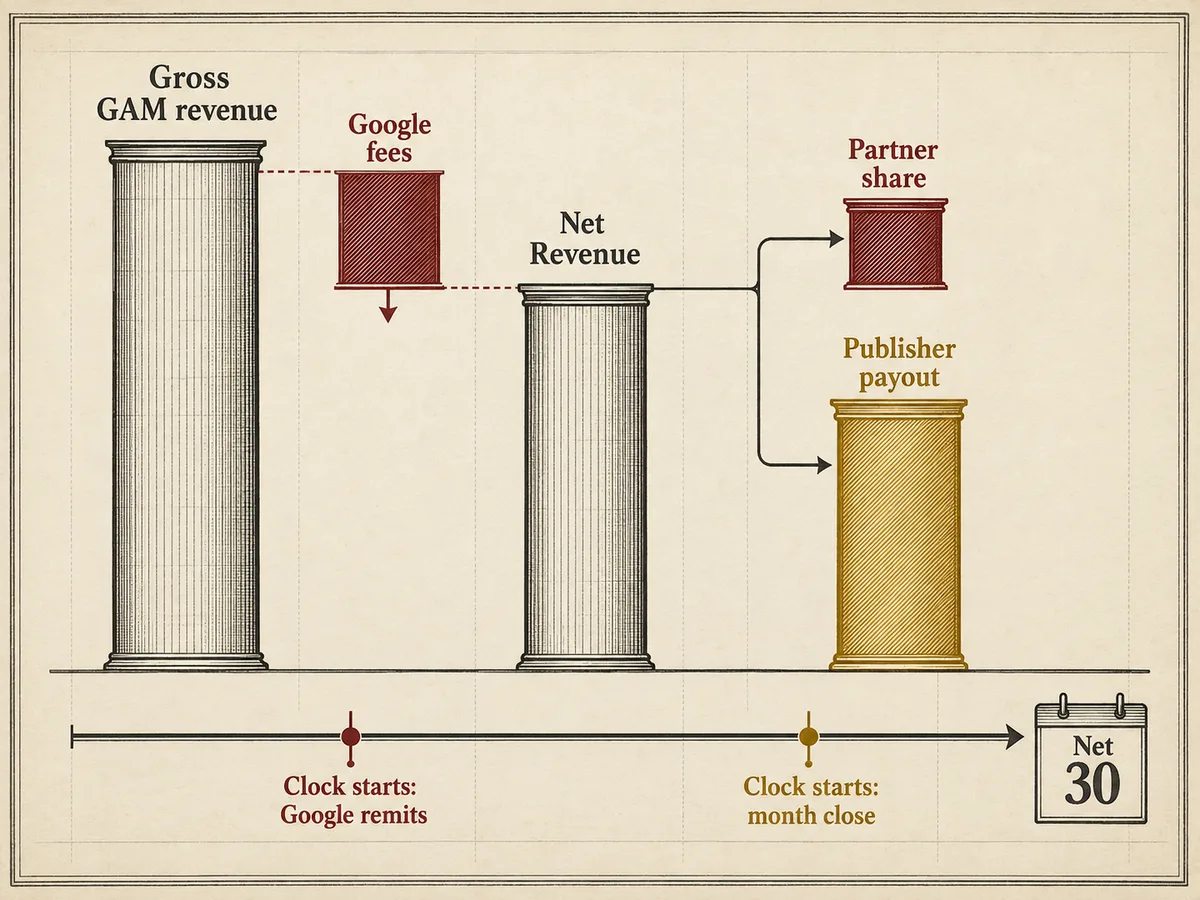
Read the definition section of the contract word by word. Look for terms like "Net Revenue", "Gross Revenue", "Monetization Revenue" and check whether the contract defines them. A contract that defines Net Revenue as GAM-reported revenue minus Google platform fees gives the publisher a verifiable base. A contract that defines it as "amounts actually received by Partner" leaves room for the partner to net out its own costs, such as hosting, reporting tools or "quality filtering", before applying the share. The first definition lets the publisher audit. The second does not.
Also confirm which demand sources the share covers. Some MCM contracts split only revenue from Google-managed demand, while other demand the partner brings, such as header bidding via Prebid or Prebid Server, direct deals, or connections to other exchanges, falls under a separate rate. The contract should list every revenue stream and its applicable share. If a stream is missing from the list, the partner can assign it any margin it wants later.
Where the share sits in the payment chain
MCM payment flows have two configurations, and the contract should state which one applies. In the first, Google pays the MCM parent, and the parent pays the publisher. In the second, managed inventory payments flow through Google directly to the publisher's own payment profile, with the parent's share deducted upstream. The second configuration reduces counterparty risk because the publisher never depends on the partner's treasury to receive money that Google has already cleared.
If the contract uses the parent-pays-publisher model, the payment terms become the most commercially important clauses in the document. Look for the payment schedule, the minimum payout threshold, the currency of settlement, and the payment method. A contract that says "Partner shall remit within 30 days of receipt of funds from Google" tells you the clock starts when Google pays the partner, not when the impression served. That can add weeks to the effective payment cycle.
We pay Net 30, and we state that in the contract rather than in a side email, because payment timing is a cost of capital question for the publisher. A publisher that receives money 45 days after month close and a publisher that receives it 30 days after month close hold materially different working capital positions, even at identical revenue shares. When you compare two MCM offers, convert each into effective monthly cash flow using your own traffic. Our CPM calculator helps you model the gross side of that comparison: enter your impressions and expected CPM, then apply each partner's share and payment terms to see the real difference per month.
Payment mechanics worth reading twice
Beyond the headline share and the schedule, several mechanical clauses determine whether the money arrives predictably.
- Reporting cadence and access. The contract should grant the publisher direct, read-only or full access to the GAM reporting interface, or guarantee delivery of reports at a stated frequency. A partner that only sends a monthly summary spreadsheet controls the publisher's visibility into its own performance.
- Deduction transparency. Every deduction between Google-reported revenue and the publisher's payable amount needs a name and a rate in the contract. Platform fees, taxes, banking costs and invalid-traffic clawbacks each behave differently, and each deserves its own clause.
- Clawback and adjustment windows. Google adjusts revenue for invalid traffic and other quality issues, often after month close. The contract should cap the adjustment window, state how the partner passes adjustments through, and forbid retroactive deductions outside that window.
- Currency and FX. If the partner settles in a different currency than Google reports, the contract should name the FX source and the conversion date. Unspecified FX terms are a silent margin.
- Audit rights. A clause that lets the publisher audit the partner's revenue records, even once a year with notice, changes how carefully the partner treats every other clause.
Each of these clauses is negotiable in most MCM contracts, and each one either protects or erodes the share you negotiated.
Clauses that decide more than the percentage
Three clause families deserve special attention because they interact with the share over time.
First, the term and termination structure. MCM agreements typically run for a fixed term with automatic renewal. The contract should state the notice period for non-renewal and the mechanics of exit: how long the transition to a new partner or to a direct GAM account takes, who owns the ad units and line item configuration, and what happens to revenue earned but unpaid at termination. A partner that holds final-month revenue hostage during a "transition review" has effectively cut your share on the way out.
Second, exclusivity and inventory commitments. Some MCM contracts require the publisher to route all inventory, or all inventory above a floor, through the partner. Exclusivity raises the partner's commitment but caps the publisher's ability to test other demand. If the contract includes exclusivity, it should include performance floors: minimum fill rates, minimum net CPMs, or a right to carve out specific placements. An exclusive contract without floors gives the partner a captive inventory supply with no delivery obligation.
Third, the change-of-share mechanism. Per Google's own documentation, the partner expresses the revenue share as a percentage in the partner assignment, as described in Setting partner revenue share, and a change to that percentage requires a new invitation because shares cannot change within an existing agreement. The contract should mirror this: any share change needs mutual written consent, a re-invitation, and a defined effective date. Watch for clauses that let the partner "adjust the share to reflect market conditions" with 30 days notice. Those clauses convert your negotiated percentage into a ceiling.

Share-change friction works both ways
The re-invitation requirement creates real friction, and publishers should understand it as a negotiating asset. Because the share cannot move inside an existing agreement, a partner that wants a bigger cut must convince the publisher to accept a new invitation, which means the publisher holds a veto. Conversely, a publisher that wants a better split must trigger the same cycle, so the request needs leverage behind it: performance history, inventory quality, or a credible alternative.
This is why the first negotiation matters more than any later one. The share you sign at the start is the share you will defend for the life of the agreement, and every improvement afterwards costs a re-invitation cycle and a renegotiation. Publishers entering MCM for the first time should treat the initial percentage as a term-length decision, not a monthly one.
The friction also has a defensive use. When a partner proposes a share reduction, the publisher can ask what the partner will offer in exchange, such as earlier payment terms, added demand sources, or reporting upgrades, because the partner cannot change the split unilaterally anyway. A partner that frames a share cut as routine administrative action is misdescribing the mechanism. The re-invitation requirement means every change is a bilateral contract event.
Negotiation points that move more money than the headline share
Experienced ad operations teams negotiate the package around the share as hard as the share itself. Five levers typically return more money than a one-point share improvement.
- Base definition. Moving the share from gross to a clearly defined net-of-Google-fees base can change effective payout by several points at the same headline percentage.
- Payment timing. Moving from "net 45 after Google remits" to a fixed Net 30 from month close improves cash flow measurably and costs the partner little.
- Demand mix commitments. Ask the partner to state in the contract which demand sources feed your inventory: Google AdX and Authorized Buyers through MCM, plus header bidding via Prebid, Prebid Server and OpenRTB connections, plus direct deals from agencies. We combine all of these in our own stack, and a partner that cannot enumerate its demand sources contractually is telling you something.
- Floor pricing and transparency. The contract should let the publisher set or approve floor prices and see bid-level data where available. Floors set unilaterally by the partner trade your revenue for their fill-rate statistics.
- Performance floors tied to exclusivity. If you give exclusivity, get minimum net CPM or fill commitments with a carve-out right on breach.
Bring traffic data to this negotiation. A publisher that shows stable impressions, clean invalid-traffic metrics and geographic mix negotiates from a different position than one that arrives with only a login and a question. Our monetization services team reviews publisher setups before contract talks precisely because inventory quality data is the strongest argument for a better share.
How we structure our own MCM contracts
We operate as an MCM parent and we also run a full SSP, so our contracts follow the structure we recommend above. We state the revenue share as a single transparent percentage, we define the base explicitly, and we pay Net 30 without conditional language. Our demand stack combines Google AdX and Authorized Buyers through MCM, header bidding through Prebid and Prebid Server over OpenRTB, and direct deals from global and local brand agencies, all competing on the same inventory. We list those sources in the contract so the publisher knows exactly what bids against their ad spaces.
We also work globally, across every country where Google monetization operates, on web, app and CTV/OTT inventory, and our filtering removes unwanted ads before they reach your users. That filtering has a cost and we absorb it rather than passing it through as an undefined deduction, which is the kind of thing you should check in any partner contract. If you hold an MCM offer from another partner and want a second read before you sign, you can request contract review and we will go through the share, the base, the payment terms and the exit clauses with you.
A working checklist for the signature stage
Before signing any MCM agreement, confirm each item in writing inside the contract, not in email.
- The revenue share percentage, and the exact base it applies to, with definitions.
- The payment schedule, threshold, currency and method, with the clock start date named.
- The demand sources covered, and the share applicable to each.
- Deduction transparency: every deduction named, with rates or a pass-through commitment.
- Adjustment and clawback windows, with a cap on retroactive deductions.
- Audit rights and reporting access.
- Term, renewal, termination notice and exit mechanics, including final payment handling.
- The share-change mechanism: mutual consent, re-invitation, effective date.
- Exclusivity terms and any performance floors attached to them.
Run the numbers before you sign, not after. Model your monthly impressions and expected CPM, apply the partner's share and payment terms, and compare the result against your current setup month by month. A contract that reads well and models badly is a bad contract. A contract with a slightly lower share but a clean base definition, Net 30 payment and real audit rights will typically outperform a flashy headline percentage wrapped in vague terms, and the difference compounds with every payment cycle you stay in the agreement.