
Two wrappers compete for the same impressions
A wrapper decides which demand partners see each impression before Google Ad Manager runs its auction, so the choice between Prebid.js and Amazon TAM shapes your CPMs, your page speed and how much you actually know about your own inventory. Both products solve the same problem: they collect bids from multiple demand sources in the page header and pass the top bid into the ad server as a line item. They approach that problem from opposite ends. Prebid.js is open source, hands you the machinery and expects you to operate it. Amazon TAM is a managed wrapper that trades control and visibility for access to Amazon's demand, which no open marketplace reaches at comparable scale.
The comparison matters because most large publishers end up running some version of both, stacked or in parallel, and the costs of each compound when they overlap. A wrapper that adds 400 milliseconds to page load can cost more in lost traffic than it adds in bid density. A wrapper that hides partner-level bid data can quietly erode your negotiating position with every demand partner you work with. Before comparing the two, it helps to be fluent in the underlying mechanic, and we cover the fundamentals in our guide to header bidding. This teardown compares both wrappers on demand access, latency, transparency and operational cost, then closes with a decision framework you can apply to your own stack.
What Prebid.js delivers and what it demands
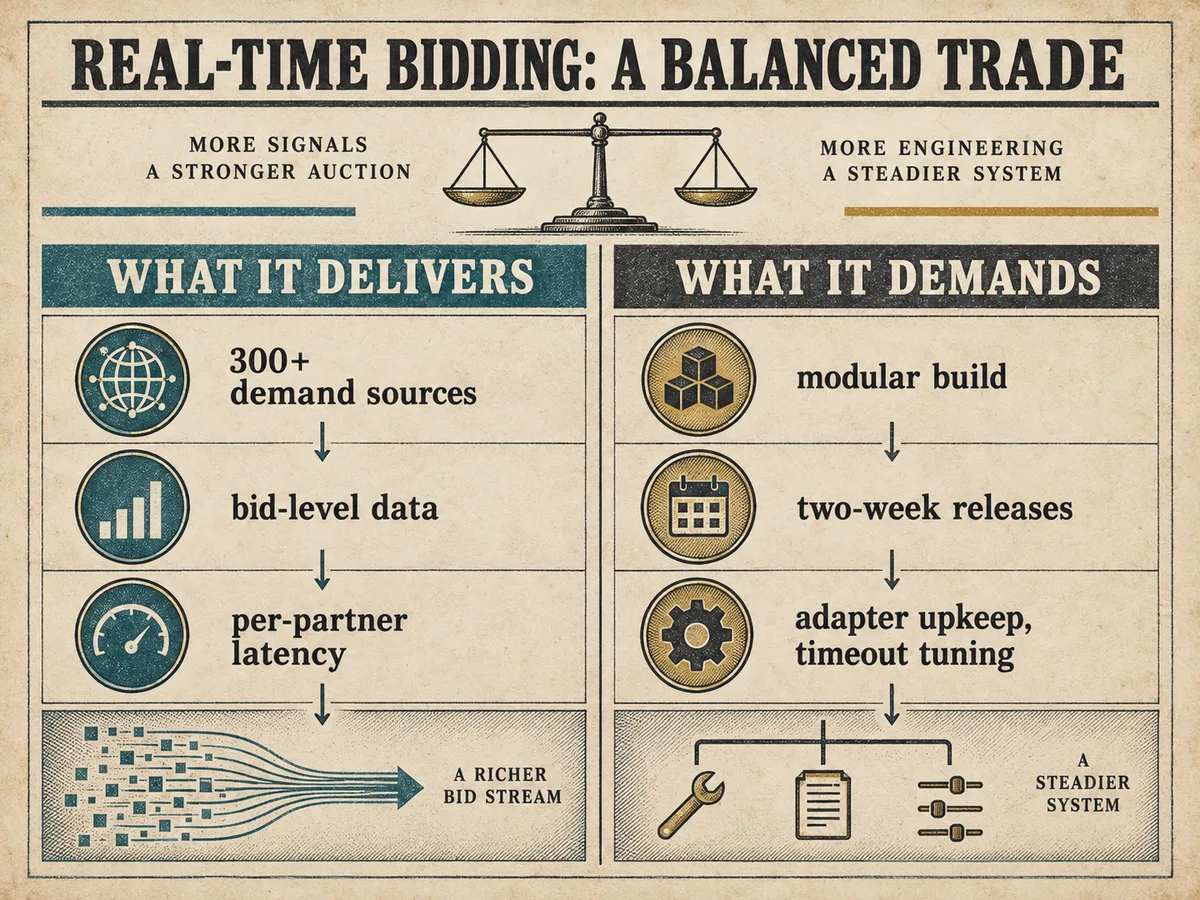
The What is Prebid.js page in the official documentation describes an open-source header bidding platform supporting 300+ demand sources, spanning global exchanges, DSPs and regional networks. That breadth is the first differentiator. The second is the auction mechanic itself: as Prebid's introduction to how header bidding works explains, multiple demand sources compete directly with the ad server before the ad server's own line items run, which lifts yield because every impression gets exposed to more buyers simultaneously.
What you get in practice is control at every layer. You choose which adapters load, you build a modular bundle that contains only the code you need, you set the timeout per breakpoint, and you decide whether video, native and banner formats share one auction. You get bid-level data for every request: each partner's gross bid, each partner's latency, each partner's fill rate by geo and size. Consent handling sits in your hands too, with modules for TCF strings and Global Privacy Control signals that route correctly to each adapter. Analytics adapters stream every bid event into your own reporting, so you can audit net versus gross revenue partner by partner.
The cost side is equally concrete. Prebid.js ships community releases on a two-week cadence, and adapters break when exchanges change their endpoints. Someone on your team owns the build pipeline, regression testing, timeout tuning and the quarterly cull of adapters that stopped clearing meaningful revenue. Debugging happens in the browser console and in your own logs, not through a vendor dashboard. For a publisher with a competent ad ops or engineering function, this is manageable overhead. For a three-person team with no developer time, it becomes the reason the wrapper rots and revenue quietly decays.
What Amazon TAM and UAM actually are
Amazon operates two related products, and the distinction between them matters more than most summaries admit. TAM, the Transparent Ad Marketplace, is a client-side wrapper in which Amazon hosts its own demand alongside a curated set of third-party exchanges. You implement Amazon's tags, Amazon supplies the GAM line items, and Amazon's shopper and purchase signals inform the bids its demand submits. UAM, the Unified Ad Marketplace, targets publishers below TAM's traffic threshold: Amazon pools your inventory with other publishers, represents it to demand partners, and pays you a net figure.
The draw is specific. Amazon's first-party data produces bids on impressions that generic cookie-based demand prices conservatively, particularly in commerce-adjacent verticals. That demand does not flow through open adapters at the same quality or volume, so the wrapper functions as a gate: you run their code to reach their buyers. Setup is light compared to a from-scratch Prebid build. Amazon provides the integration, the line item structure and a dashboard, which makes TAM genuinely attractive for teams without engineering bandwidth.
The trade-offs follow directly from that gatekeeping model. Reporting arrives as aggregates: net numbers by placement and date, not a per-partner bid stream you can audit. On UAM, Amazon's revenue share is undisclosed, so you cannot decompose your check into gross bids and Amazon's cut. Timeout behavior, adapter configuration and auction logic sit inside a black box that you cannot tune, and the third-party partners Amazon curates into TAM are a subset of what the open ecosystem offers. You accept opacity on the mechanics in exchange for demand you cannot otherwise reach.
Demand access is the real dividing line
Prebid's adapter library is wide and shallow in a specific sense: it connects you to hundreds of demand sources, but Amazon's own DSP demand is not among them in an open, fully transparent form. TAM's partner list is narrow and deep: fewer exchanges, but exclusive access to bids informed by Amazon's shopper data. This asymmetry drives most real-world architecture decisions more than any feature comparison does.
Bid density and bid value pull in different directions. Three hundred adapters produce dense competition on every impression, which compresses the value of each individual partner but raises the floor across the board. Amazon's demand produces sparse but occasionally dominant bids, concentrated where purchase intent correlates with your content. A publisher in tech reviews, consumer goods or finance may see Amazon demand clear a meaningful share of impressions at CPMs well above the open market, while a publisher in B2B software may see it barely participate.
The practical consequence: this is rarely a binary choice. A large share of professional setups run TAM as a parallel bidder alongside a Prebid.js auction, treating Amazon's wrapper as one more demand source feeding the same GAM ad server. That pattern captures both the breadth of open demand and the exclusive Amazon bids, at the cost of running two wrappers, two sets of line items and two debugging surfaces. It works, but it doubles the operational surface area, which is exactly the overhead the next two sections quantify.
Latency, page weight and operational load
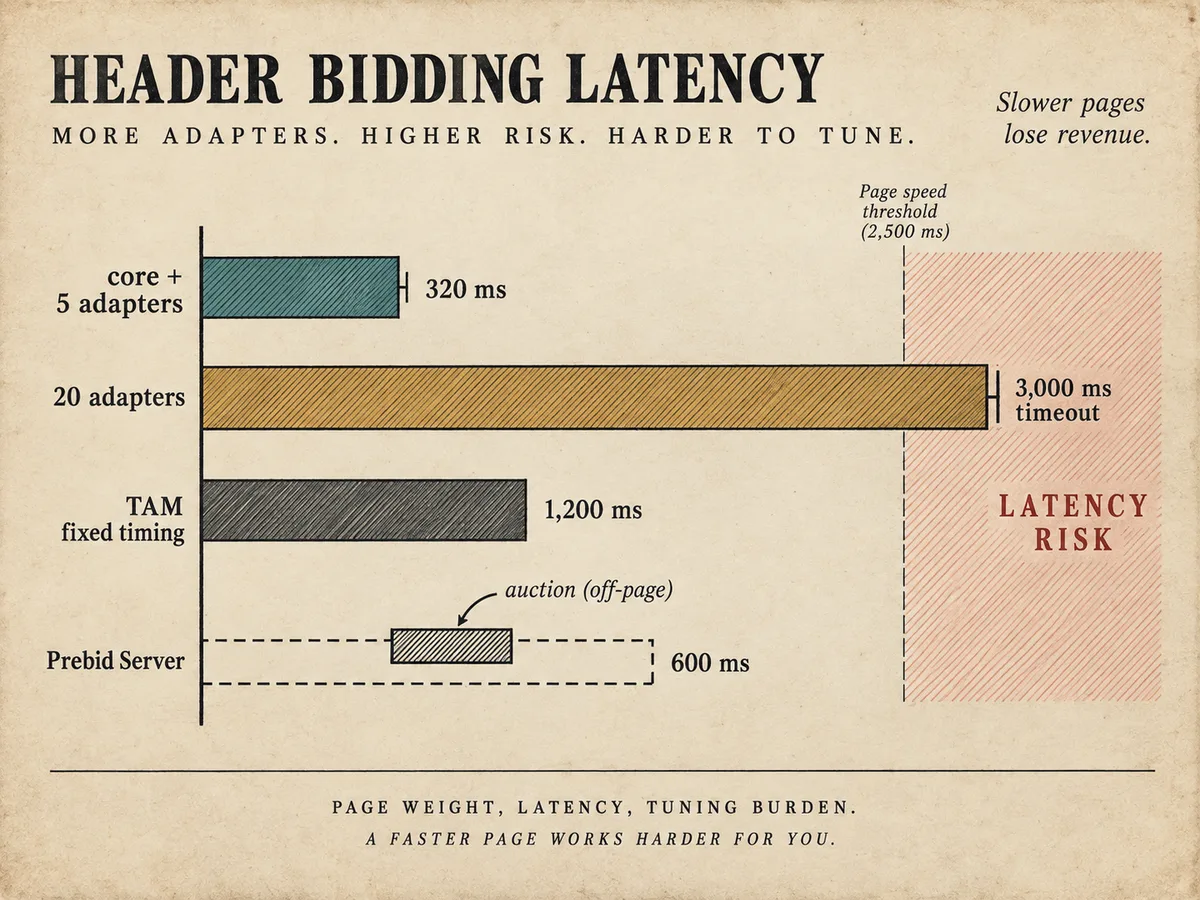
Both wrappers are client-side by default, which means both add JavaScript weight and network requests to your critical path. Prebid.js loads only the modules you include in your build, so a disciplined publisher can hold the core library plus five adapters to a modest footprint. Every adapter you add contributes a request inside the auction window, and a timeout set generously enough to catch slow partners delays your ad calls, your Largest Contentful Paint and, at the margin, your search rankings. The tuning knobs exist, but you have to turn them yourself.
TAM moves in the opposite direction on configurability. You accept Amazon's auction timing and tag structure, which reduces your tuning burden and also removes your ability to optimize it. The wrapper is engineered competently, and for many publishers its out-of-the-box latency profile beats a neglected Prebid setup with 20 adapters and a 3,000-millisecond timeout. The comparison is often less about the platforms and more about whether anyone on your side is actively managing the client-side auction.
Server-side execution changes the equation for both. Prebid Server moves the auction off the page, and Google's documentation on how Open Bidding works describes the same principle from the ad server's side: third-party demand competes in the unified auction server-side, with no wrapper code on the page at all. You gain page speed and lose real-time bid visibility, and cookie syncs become harder, which can dent match rates in some geographies. For publishers fighting core web vitals, server-side is the direction the whole market is moving, and a wrapper decision made purely on client-side merits may need revisiting within a year.
Transparency, reporting and who holds the data
Prebid.js gives you gross bids, per-partner latency, per-partner fill and every bid event in your own analytics pipeline. This matters beyond debugging. When you can see that a partner bids a 0.40 USD gross CPM and pays a 0.28 USD net, you can renegotiate or replace that partner with evidence. When you can see fill rates by geo and size, you can route formats intelligently. The data layer of Prebid is arguably its most valuable layer, because it converts your demand relationships from vendor relationships into measurable, comparable transactions.
TAM reports net figures through its own dashboard, and UAM adds an undisclosed revenue share on top. You cannot decompose the number, you cannot compare Amazon's bid stream against your open market demand at bid level, and you cannot verify whether a weak month reflects weak demand or a widened cut. None of this means the numbers are wrong, it means you cannot audit them, and unauditable revenue is weaker revenue in every negotiation you will ever run.
The GAM line item structure follows the same pattern. A Prebid setup with price granularity lets you see exactly which price band cleared, per partner, in your own ad server reporting. TAM's line items report Amazon's aggregate, and partner-level detail stays inside Amazon's reporting. Publishers who treat revenue data as an asset choose accordingly. Publishers who just want the check to arrive each month accept the opacity, and both positions are defensible once stated honestly.
A decision framework
The honest answer to "which wrapper wins" is that the winner depends on four variables, and the framework below maps each product to the conditions that favor it. Score yourself against each condition before committing.
- Choose Prebid.js as your primary wrapper when you have engineering or ad ops resources to own releases, adapter maintenance and timeout tuning, when partner-level revenue data drives your negotiations, and when your inventory spans formats and geographies that open demand serves well.
- Choose TAM or UAM when Amazon-informed demand demonstrably clears your inventory at premiums, when your team lacks the capacity to operate an open-source auction, and when net reporting with an undisclosed share is acceptable for your accounting and planning.
- Run both in parallel when your vertical sits in the commerce-intent band where Amazon bids dominate, your traffic justifies the dual setup, and someone owns the coordination: line item conflicts, timeout alignment and unified reporting across two systems.
- Move the auction server-side when page speed or core web vitals cap your client-side budget, using Prebid Server or Open Bidding, accepting reduced bid visibility in exchange for a faster page.
Two cautions apply. First, do not treat TAM's UAM pool as a long-term home if your traffic is growing, because the undisclosed share and the aggregate reporting cap your upside precisely as your inventory becomes more valuable. Second, do not treat a Prebid install as a one-time project, because an unmaintained wrapper with broken adapters performs worse than no wrapper at all. The wrapper you can staff and maintain beats the wrapper with the better feature list on paper.
How WireAds collapses the wrapper dilemma
Most of the pain in this comparison comes from assembling demand yourself: one wrapper for open exchanges, another for Amazon, a separate MCM or AdX relationship, direct deals negotiated piecemeal. We built our SSP to absorb that assembly work. We connect Prebid.js and Prebid Server adapters, OpenRTB endpoints, Google MCM with AdX demand, and direct deals from global and local brand agencies into one auction, so each of those demand sources bids against your inventory simultaneously instead of through parallel integrations you maintain.
For a publisher, this changes the question. You connect once through a Prebid-compatible integration, and our aggregation surfaces the combined demand behind it. Your Prebid integration talks to the WireAds SSP, and the SSP does the work of aligning exchange demand, Google demand and agency direct deals so the highest bid wins each impression. You keep the open-source wrapper you already run, or you start one, and the demand-side complexity sits with us.
The operational terms follow the same logic. We work CPM-based and pay Net 30, we filter unwanted and low-quality ads before they reach your inventory, and we operate globally across web, app and CTV/OTT wherever Google monetization is available. The wrapper question does not fully disappear, because the choice between client-side and server-side execution still belongs to you, and Amazon's exclusive demand still requires their wrapper if you want it. But the version of the dilemma where you must build and staff everything yourself dissolves, and what remains is a simpler decision about execution layer, not a second job.