Programmatic selling did not start with supply-side platforms. It started with ad networks that pooled inventory and sold it in bulk, with publishers receiving a share of an opaque price. The SSP emerged because publishers wanted a technology layer that would expose their inventory to many buyers at once and let competition, rather than a single sales team, set the price. That original mission has been rewritten several times since, and the version of the SSP you work with this year looks almost nothing like the one from a decade ago. If you currently sell inventory through a supply-side platform, or you are evaluating one, the history matters because it explains why certain capabilities exist and why certain promises should raise a red flag.
Ad Networks First, Then a Layer for Publishers
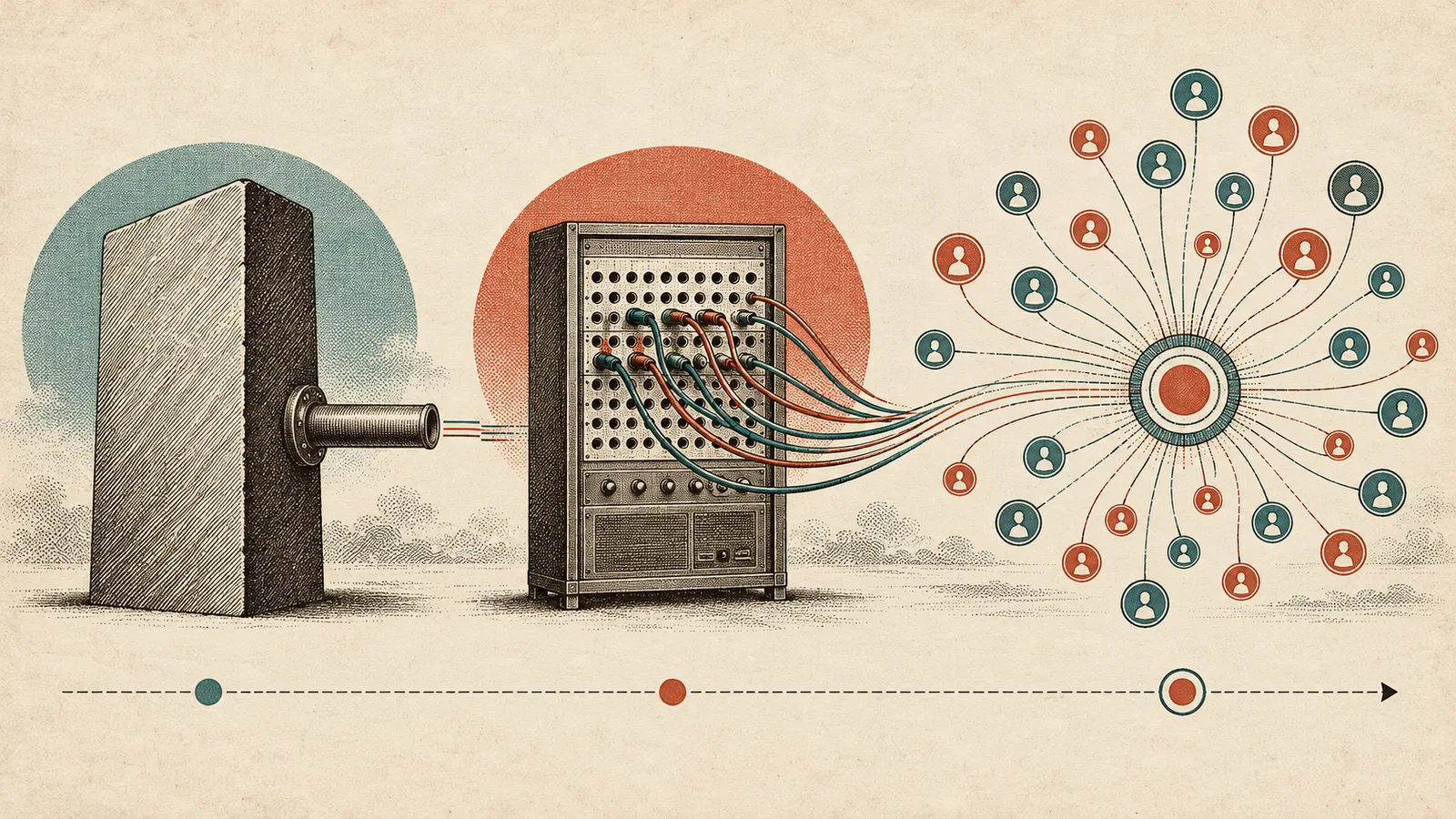
The first generation of programmatic intermediaries were ad networks: aggregators that bought inventory cheaply, packaged it, and resold it to advertisers at a margin. Publishers had little visibility into what the inventory actually sold for, and the network had every incentive to keep it that way. SSPs grew out of that model as a separate role: instead of owning the inventory and the margin, the platform would run an auction on the publisher's behalf and take a transparent technology fee. The SSP history and evolution follows this arc, from network-style aggregation toward independent auction technology, and then toward a broader programmatic channel that includes real-time bidding, private marketplaces, and automated direct deals.
Two things happened as that arc progressed. First, the auction itself became standardized: buyers and sellers needed a common language for describing an impression, a user, a placement, and a floor price. That language became OpenRTB. Second, the SSP stopped being a single demand source and became a switchboard. A modern supply-side platform does not bring one buyer to your inventory; it brings hundreds, through exchanges, DSP integrations, agency deals, and marketplace partners, and it runs them against each other in a single auction.
This is the single most important thing to understand about the modern SSP: its value is not the software, it is the demand stack behind the software. Two platforms can run identical auction logic and produce wildly different revenue for the same publisher, purely because of which buyers they connect to and how hard those buyers compete.
Header Bidding Broke the Walled Auction
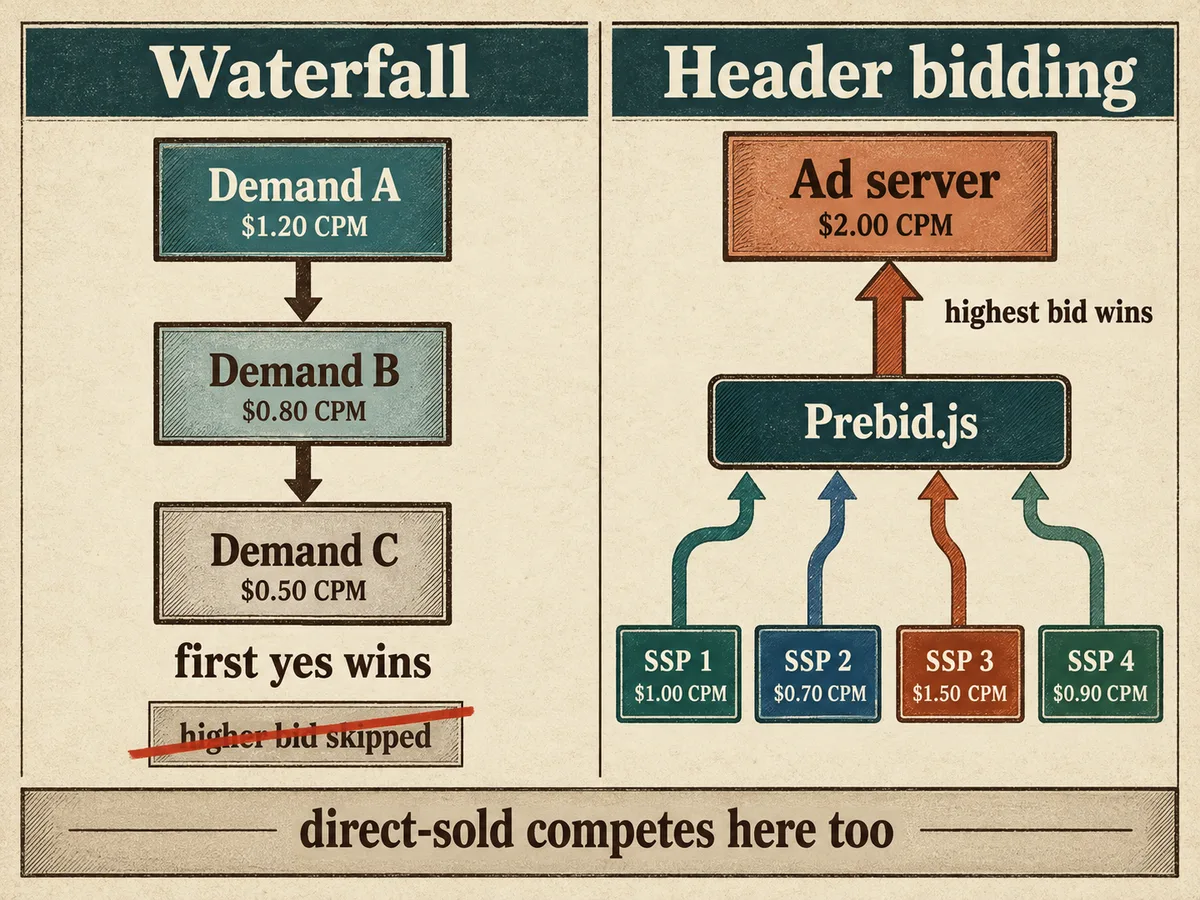
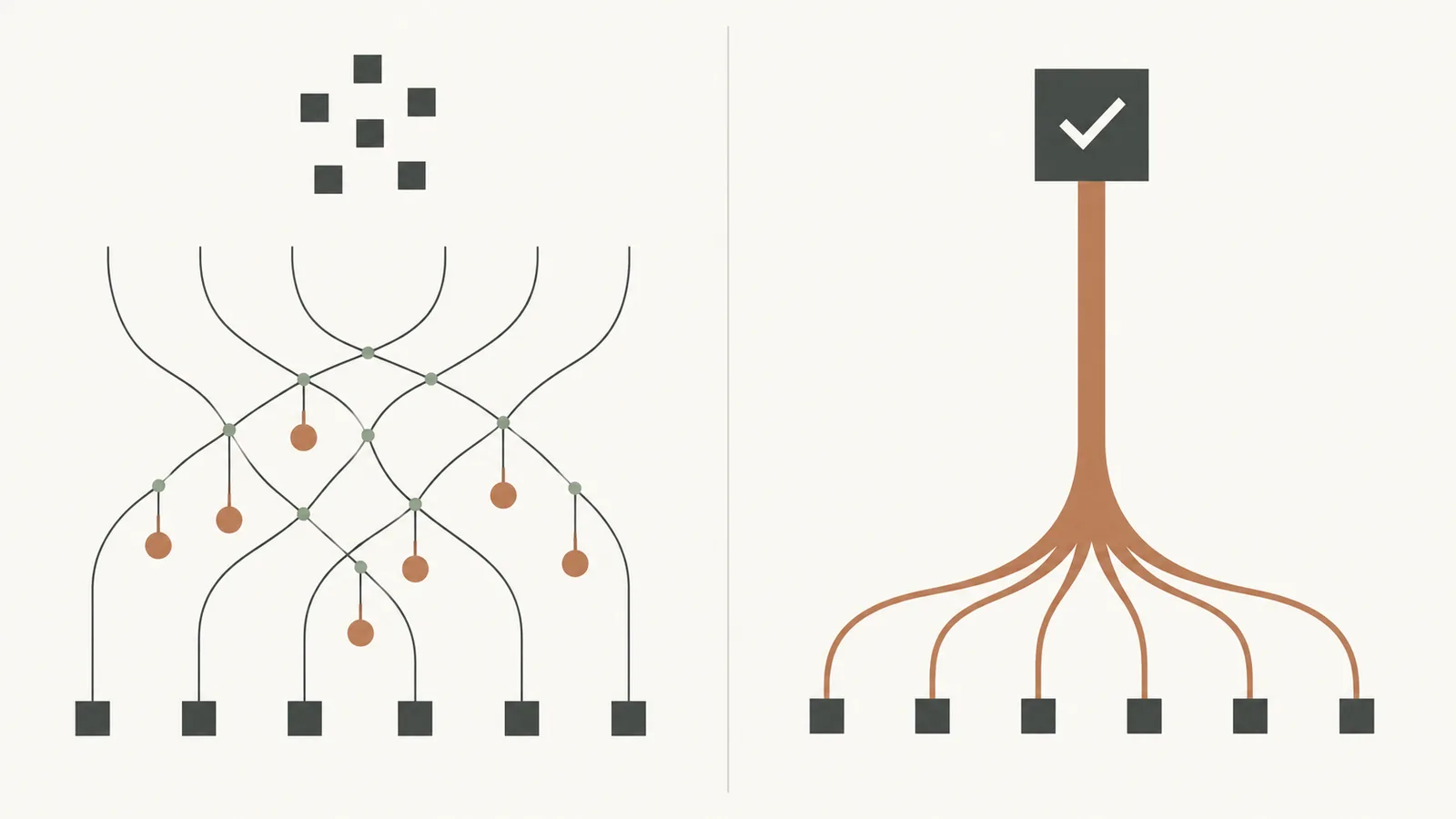
The next major shift came from publishers, not from the platforms. For years, Google's ad server ran a sequential waterfall: it asked one demand source, then the next, and the first one willing to pay won, even if a later buyer would have paid more. Header bidding inverted that. By running an auction in the page before the ad server call, publishers could collect bids from many demand sources at once and pass the highest one into the ad server to compete with direct-sold campaigns.
The consequences ran deep. Publishers gained leverage because every SSP suddenly had to compete on price and payment terms rather than on exclusivity. Prebid.js turned header bidding into an open-source commodity, which meant the wrapper itself stopped being a differentiator and the demand behind it became the only thing that mattered. And the ad server, which had been the walled garden controlling the auction, became one competing demand source among many.
The practical legacy for publishers today: any partner whose main pitch is "we have a wrapper" is selling you something you can get for free. The pitch that matters is demand depth, auction transparency, and how the partner handles floor prices, bid shading, and the final call into the ad server. When we onboard a publisher, we run Prebid alongside Google Ad Manager and Google MCM demand, and the reason is mechanical: more independent bidders in a single auction means higher clearing prices, not because of cleverness, but because of competition.
Consolidation, MCM, and the Return of Scale Requirements
The middle chapter of SSP evolution was consolidation. Hundreds of small platforms merged, closed, or retreated to niches, and the survivors clustered around two assets: unique demand relationships and scale. Google formalized the scale requirement through Multiple Customer Management, or MCM. Under MCM, publishers without a direct AdX relationship monetize through a managing partner, and that partner's account standing, revenue share, and demand quality directly determine the publisher's results.
This changed partner selection in a concrete way. Before MCM, a publisher might tolerate a mediocre SSP because it was one tag among many. After MCM, the partner you choose for your Google demand sits inside your revenue chain permanently, and switching costs are real. Ask any prospective partner how their MCM structure works, what revenue share they pass through, and whether you can see it in reporting. A partner that answers those three questions plainly is usually a partner that has nothing to hide.
Scale also matters for a second reason: agency direct deals. Global and local brand agencies sign insertion orders with platforms that can guarantee volume and quality across regions. A small SSP without agency relationships cannot bid those campaigns into your inventory at all, no matter how good its technology is. When we describe our demand stack, we include direct deals from brand agencies alongside open marketplaces, exchanges, and DSPs, because a stack that only has open exchange demand leaves money on the table on every premium impression.
OpenRTB Standardized the Bid Stream
Real-time bidding only works if every participant describes an impression the same way. The OpenRTB standard evolution at the IAB Tech Lab defines that common description: the bid request, the bid response, the ad object, and the protocols that carry them. As the standard has evolved, it has absorbed new object types and signals, most notably for connected TV and digital video through the VAST-compliant video object, and new fields for privacy and identity signals.
For publishers, OpenRTB matters in three specific ways. First, it is the reason a bid from any DSP can compete in your auction without custom integration work; the standard is the plumbing. Second, its signal quality determines your CPMs: bid requests that carry accurate placement metadata, viewability signals, and proper supply chain information let buyers bid with confidence, and buyers pay more when they can trust what they are buying. Third, its evolution pace determines what inventory formats you can sell at all. If your partner supports current OpenRTB video and CTV objects, you can sell into TV budgets. If it does not, you cannot, and no amount of optimization will fix that.
We treat OpenRTB as the backbone of our stack: our SSP consumes Prebid, oRTB, Google MCM, Google AdX, and direct deal demand and normalizes all of it into a single competitive auction. If you want to go deeper on the mechanics, our guide to OpenRTB for publishers breaks down the bid request field by field and shows which signals move CPMs.
What Shifted This Year
Three shifts define the current moment, and none of them are marketing trends; each one changes auction mechanics or the demand pool.
Privacy signal enforcement. Global Privacy Control and TCF consent signals now flow through the bid stream as first-class OpenRTB fields, and buyers enforce them programmatically. Inventory that passes a valid consent string gets bid on; inventory that does not gets skipped or bid at remnant prices. A partner that handles consent propagation correctly protects your CPMs; one that does not silently loses you demand. Ask how a prospective SSP passes consent through Prebid and oRTB and what fill rate drop it sees on traffic without valid consent.
Supply chain transparency as a buying requirement. ads.txt and app-ads.txt are table stakes, but the current enforcement layer is sellers.json plus the SupplyChain object. Sophisticated buyers now use the SupplyChain object to detect intermediaries adding cost without adding value, and they discount or avoid inventory with unclear ownership paths. This means every hop between you and the buyer is now visible, and every unnecessary hop costs you bid depth. Fewer, well-integrated partners with clean supply chain records outperform a sprawl of tags, and this is a structural argument for consolidating demand into a single auction point.
CTV and OTT demand growth. Connected TV budgets are moving into programmatic channels, and they carry CPMs an order of magnitude above display. Selling into them requires a partner with VAST support, proper OpenRTB video objects, and app or OTT integration capability. If your audience includes any video or TV-like environment and your partner cannot sell it, that demand simply does not exist for you.
How the Shifts Should Drive Partner Selection
The historical arc, from network to auctioneer to demand aggregator, gives you a concrete checklist. A supply-side platform today should clear all of the following, and each item maps directly to one of the evolutionary stages above.
It should aggregate demand, not represent one buyer. Ask for the composition of the demand stack: open exchange demand, DSP integrations, agency direct deals, and Google demand through MCM and AdX. A stack that combines all of these, and runs them against each other in a single auction, is doing what the SSP form was built to do. The WireAds platform is built on exactly this model, and we publish the composition because we think opacity about demand sources is the oldest problem in this industry.
It should be transparent about the auction and the money. You should know your floor price logic, your payment terms, and your revenue share. We pay Net 30 and work on CPM-based pricing, and we state both up front because payment terms are a solvency signal: a partner that stretches publishers to Net 90 is often financing its own operations with your receivables.
It should filter demand, not just fill it. Open marketplaces contain ads that damage publisher brands: misleading creatives, auto-redirects, low-quality categories. Filtering them costs fill rate and the partner knows it, so weak partners quietly skip the work. We hold our ad sources to strict quality standards and filter unwanted ads before they reach your inventory, because a redirected user does not come back, and the publisher, not the SSP, pays that cost.
It should cover your formats and geographies. Programmatic demand is not uniform across formats or countries, and a partner strong in US display may have no CTV demand in your market. We operate globally in every country with Google monetization, across web, app, and CTV/OTT, because format and geography coverage determines which budgets can even see your inventory.
Questions That Cut Through the Pitch
Bring these five questions to any partner conversation, and score the answers against what the evolution of the SSP actually rewards.
- Which demand sources bid in my auction, and can you list them by category?
- How does your MCM structure affect my Google revenue, and what share do you pass through?
- How do you propagate consent signals through Prebid and OpenRTB, and what happens to fill rate without them?
- What is your ads.txt, sellers.json, and SupplyChain setup, and how many hops sit between me and the buyer?
- What are the payment terms, and what does your ad quality filtering reject?
A partner with strong answers to all five has demand depth, clean supply chain, privacy compliance, honest economics, and brand protection. That combination is what two decades of evolution selected for, and it is what separates a platform that will grow with your inventory from one that will quietly tax it. For a grounding in the mechanics behind all of this, our guide to programmatic advertising explained covers the full pipeline from bid request to payment, and it is the right reference point before you sign anything.
The SSP has evolved from a margin-taking aggregator into a demand aggregation and auction infrastructure business. Publishers who understand that arc, and who select partners on demand depth, transparency, and filtering rather than on wrapper features or promises, capture the value that evolution created. The platforms that survived did it by doing the unglamorous work: connecting more buyers, standardizing more signals, and cleaning up the supply chain. Choose the partner that still does that work, and check whether they can prove it.