
Multiple Customer Management, the framework Google introduced in 2021 to replace third-party granular access, defines two modes of partnership: Manage Inventory and Manage Account. Most publishers evaluate an MCM offer on a single axis, access to Google Ad Exchange demand through the partner's Ad Manager network. That axis is real, but it hides most of the value. A well-structured MCM relationship changes your available deal types, your payment terms, your ad quality controls, your supply chain transparency and your negotiating position with media agencies, and under Manage Inventory it does all of this while you keep full ownership of your own Ad Manager account. The sections below cover the benefits that rarely appear in a partner pitch, with Manage Inventory as the model that preserves publisher independence at every step.
Manage Inventory versus Manage Account
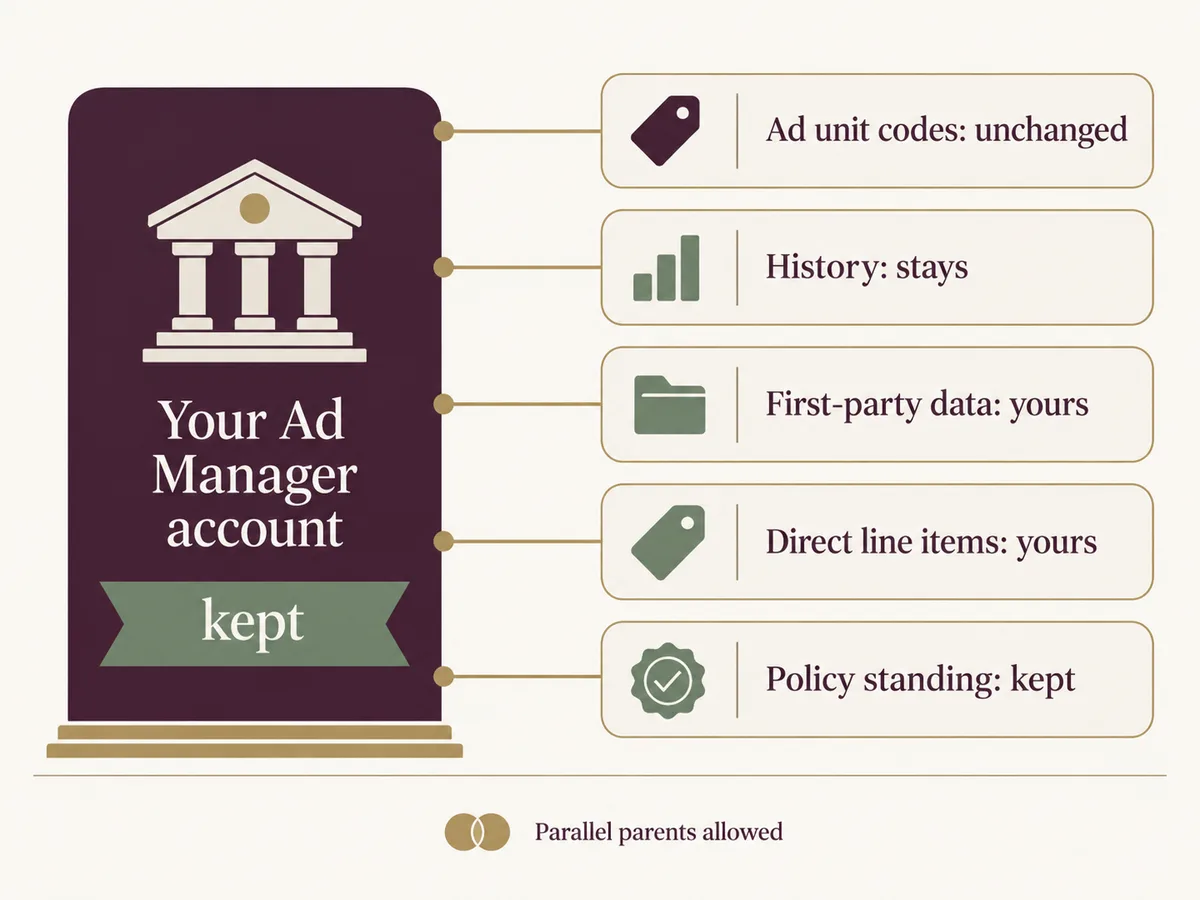
Under Manage Account, the parent company controls a dedicated Ad Manager account created for the child publisher, and the publisher operates inside the parent's infrastructure. Under Manage Inventory, the publisher keeps its own Ad Manager account and delegates inventory management to the parent. Google's Benefits of Manage Inventory documentation states the core property plainly: children keep their own account, and they can authorize multiple parents at the same time. That sentence carries most of the strategic weight in any MCM negotiation. The relationship is a delegation, not a transfer, and the publisher can run parallel partnerships and compare them on real numbers. When we onboard a publisher, Manage Inventory is the default we propose, and we propose it for reasons that favor the publisher as much as us: the publisher's leverage, data and exit options all survive the partnership intact.
Your account, your data, your history
Because the child keeps its Ad Manager account, nothing migrates at onboarding. Ad unit codes stay the same, so a site that joins or leaves a program does not re-tag a single slot, and live campaigns keep serving without interruption. Historical reporting stays in place, which matters when you analyze seasonality, audit a partner's performance claims or defend your rates in an agency negotiation. First-party data, audience segments and contextual targeting you have built remain yours to keep or export. Line items you have sold directly remain under your control, so a publisher with a small direct sales operation can layer MCM demand underneath its own campaigns instead of routing its own deals through a third party. The account also retains its policy standing with Google. A publisher that spent years building a clean compliance record does not restart from zero because it joined a program, and that clean record directly affects the demand Google will route to your inventory.
Deal types that open with Ad Exchange
AdX access is the headline benefit, but the concrete change sits in deal mechanics. Once your inventory monetizes through Ad Exchange, preferred deals, private auctions, the ad review center and consolidated billing become available in Ad Manager, as Google's Ad Exchange features in Ad Manager documentation confirms. Preferred deals let a buyer lock a fixed price on specific inventory before the open auction runs. Private auctions invite a selected group of buyers to compete against a floor price you set. Programmatic guaranteed transactions bring agency commitments with reserved volume into the same system that serves your open market demand. Without AdX eligibility, a publisher's direct options shrink to manual insertion orders negotiated one by one. With it, the full transaction spectrum runs through one ad server, and the MCM parent's job becomes placing your inventory into the right deals at the right floors. A partner that also negotiates on your behalf turns these deal types from passive features into active revenue: the parent's trading desk can package your inventory into private auctions that individual publishers cannot access on their own.
Demand aggregation: MCM does not replace header bidding
A common misconception treats MCM as an alternative to header bidding. In practice the two run in parallel, and the combination produces the results publishers actually want. Prebid.js or Prebid Server collects bids from demand partners over OpenRTB, while the MCM parent's AdX demand competes in the same auction inside Google Ad Manager. Our SSP platform works exactly this way: we combine Prebid, OpenRTB, Google MCM and Google AdX demand, plus direct deals, and push all of it into a unified auction so the highest bid wins each impression. For the publisher, this means the MCM program does not cannibalize existing demand partnerships. It adds a demand source that typically bids on inventory the open exchanges underprice, especially in geographies where AdX coverage outperforms smaller exchanges. The unified auction also removes the classic leak where header bidding demand and AdX demand bid in separate waterfalls and the lower of the two wins the impression.
Agency demand and direct deals
The benefit publishers underrate most: an MCM partner with agency relationships can route direct campaigns to your inventory. Established ad networks and SSPs hold relationships with global and local brand agencies, and those agencies buy guaranteed and preferred inventory that never reaches the open market. Through our Direct Deals desk, we place publisher inventory into campaigns negotiated directly with agencies, at CPMs the open auction rarely matches, because the buyer pays for certainty: known placement, known format, known brand context. A solo publisher with two million monthly impressions has little leverage with a media agency. The same inventory inside an MCM program that aggregates thousands of publishers becomes part of a package an agency will reserve at a premium. The publisher keeps the independence of Manage Inventory and gains the negotiating weight of a network, which is the exact combination solo sellers cannot build alone.
Payments, terms and consolidated billing
MCM also changes the payment relationship, and payment terms belong in any value calculation. When the parent operates as an ad network under Manage Inventory, Google pays the parent for AdX revenue and the parent pays the publisher on its own schedule. That makes the partner's terms part of the deal's value. We pay Net 30, and we consolidate: instead of chasing five demand partners for five payments at five different minimum thresholds, the publisher receives one payment covering all demand routed through us. For small and mid-sized publishers, thresholds at individual exchanges often delay revenue by months. A single consolidated Net 30 payment improves cash flow predictability without any work on the publisher side. It also simplifies accounting, because one remittance with one statement replaces a stack of small invoices, and any revenue dispute goes to one contact instead of five support queues.
Ad quality control as a program feature
AdX demand includes good creatives and bad ones, and the ad review center gives the parent tools to tell them apart. The difference between MCM programs shows in how actively the parent uses those tools. We filter aggressively: misleading creatives, auto-redirects, heavy interstitials and low-quality ads get blocked before they reach publisher pages, because we hold our ad sources to strict brand quality standards and a single bad creative costs more in user trust and bounce rate than it pays in CPM. Publishers can layer their own blocks in Ad Manager on top of ours. The practical benefit: the publisher inherits a curated demand stack instead of a raw exchange feed. For sites with a brand to protect, this curation often outweighs a marginal CPM difference, since one redirect scam ad can undo months of audience building.
Multiple parents and the exit option
Manage Inventory lets a child authorize multiple parents simultaneously, and that fact reshapes the power balance of the whole relationship. A publisher can run one MCM parent on part of its inventory and another parent on the rest, measure both over a full quarter, and shift allocation based on results. Exiting is equally direct: the publisher revokes the delegation in Ad Manager, the inventory stops flowing to the parent, and no re-tagging or data migration follows because the account never moved. Compare that with Manage Account, where the parent owns the infrastructure and leaving means rebuilding from scratch. We treat this reversibility as a feature of our program, not a risk to it. A publisher that can leave freely stays for performance, and that discipline keeps our CPMs and fill rates competitive instead of resting on lock-in.
Supply chain transparency buyers can verify
Every MCM parent appears in your ads.txt and in the sellers.json file that Authorized Buyers consult before bidding. A direct, verified supply path, expressed through accurate ads.txt entries, a complete sellers.json and a valid SupplyChain object on each bid request, tells buyers exactly where your inventory comes from. Buyers pay more for transparent supply and discount or skip opaque paths, so a correctly structured MCM delegation can raise effective CPMs without changing anything else on the page. When we onboard a publisher, we audit the ads.txt file, add our entries and make sure the SupplyChain object travels intact on every impression, because demand that cannot verify supply bids lower or not at all. The same discipline applies to app publishers through app-ads.txt, and to CTV inventory where buyers scrutinize the supply path hardest.
What WireAds brings to an MCM partnership
Google's Multiple Customer Management overview describes the provider's role in three verbs: providers consult, represent and manage networks or inventory on a publisher's behalf. We do all three under Manage Inventory, on CPM-based terms, with Net 30 payments, across every country where Google monetization operates, on web, in apps and on CTV and OTT. Our demand stack combines Prebid, OpenRTB, Google MCM, Google AdX and direct deals from global and local brand agencies, and all of it bids against itself on your inventory. The WireAds publisher program keeps your Ad Manager account in your hands, your reporting transparent and your exit option open, and we consider those properties the foundation of the partnership rather than concessions.
Questions to ask before you sign
Before signing any MCM delegation, ask the partner six questions. Which mode do you propose, Manage Inventory or Manage Account, and why? What are the payment terms and the minimum threshold, in writing? Which deal types will you actively negotiate for my inventory, and how do private auctions and preferred deals enter my account? How do you filter creatives, and can I see your block policies? How will my ads.txt and sellers.json change, and will the SupplyChain object stay intact? Can I run a second parent in parallel, and what does leaving look like? A partner with confident answers to all six earns the delegation. A partner that dodges the mode question or the exit question tells you everything you need to know about how the relationship will go.